24 May 2012

Stage 18 results and Stage 19 prediction ...

Italian Andrea Guardini won Stage 18 of the Giro d'Italia today, just beating out Mark Cavendish of Great Britain.  Below is a comparison of the winning time with our prediction, followed by Guardini's average speed for the 139-km (86.4-mile) stage.
  • Stage 18:  3h 00' 52" (actual), 3h 11' 49" (prediction), 10' 57" slow (6.05% error)
  • Stage 18:  12.8 m/s (28.7 mph)
I'll take a 6% error on a race I just started modeling this year, and at the end of the race at that.  As  I have noted in previous posts, modeling these cycling stages is not only a great deal of fun, it is hard.  If my model is too simple, I am glossing over complexities that influence a race.  If my model is too complicated, I am making too many a priori assumptions, many of which are certain to be incorrect in the actual race.

Okay, on to Stage 19, which looks to be a brutal mountain stage.  Starting in the north Italian city of Treviso, the stage ends 198 km (123 miles) later in Alpe di Pamepago, which is in the heart of the Dolomites.  Beginning at just 15-m (49-ft) elevation, cyclists will reach the 2047-m (6716-ft or 1.27-mile) peak at Passo Manghen after 123.3 km (76.6 miles) of biking.  The final 8 km (5 miles) will make for a grueling uphill to the finish line.  Here is our prediction:
  • Stage 19:  5h 43' 12" (prediction)
I hope cyclists have enough fuel in the tank to make it up the final climb fast enough that our prediction is not too fast!

23 May 2012

Giro d'Italia Stage 18 Prediction

Our prediction for tomorrow's Stage 18 is below.
  • Stage 18:  3h 11' 49" (prediction)
The downhills from San Vito Cadore to Vedelago should make for some wonderful racing!  Riders should not kill themselves on tomorrow's stage because two monster mountain stages await them on Friday and Saturday.

Not a bad first stage!

Joaquin Rodríguez won today's Stage 17 of the Giro d'Ialia.  The Spaniard just edged Italian Ivan Basso in an exciting finish.  Below is how today's result compares to the prediction I posted yesterday.
  • Stage 17:  5h 24' 41" (actual), 5h 28' 26" (prediction), 3' 45" slow (1.15% error)
I told my student, Brian Ramsey, that that's not bad for his very first stage prediction!  Below is how the average speed came out for Joaquin Rodríguez in the 187-km (116-mile) stage.
  • Stage 17:  9.60 m/s (21.5 mph)
Check back soon for a prediction for tomorrow's Stage 18, which looks to have a lot of fast downhills.

22 May 2012

A try at Giro predicting ...

The 2012 Giro d'Italia is nearly over.  I've only modeled a couple of stages of this race in the past, mostly because my spring semester keeps me extremely busy as the race gets underway.  This year has been no exception.  A rising sophomore Lynchburg College physics student, Brian Ramsey, is working with me this summer in preparation for modeling the 2012 Tour de France.  We thought a nice warm-up exercise would be to model a few stages of this summer's Giro.


To introduce Brian to what it's like to stick one's neck out for science, I had him model tomorrow's Stage 17 using the model I developed for the Tour de France.  Tomorrow's stage is a wonderful mountain ride that takes cyclists from Falzes to Cortina d'Ampezzo.  Here is our prediction for tomorrow's stage:
  • Stage 17:  5h 28' 26" (prediction)
We shall see what happens!

15 May 2012

Ping-Pong Physics and Vlogging

One of my favorite results from Classical Mechanics has to do with the stability of rigid bodies as they rotate about certain axes.  I demonstrate this theorem in a YouTube video, which is my first attempt at vlogging (though these words may render my attempt but a partial one!).  Click on the video below (or click here) to see and hear me talking about rotating ping-pong paddles.  If you don't own a ping-pong paddle, try my demonstration at home with your television's remote control.  You should easily be able to find the axis about which rotation is unstable.  That's how I discovered one of nature's beautiful workings when I was a teenager.


06 May 2012

Way to go Owls!

Ever since my family and I lived in Sheffield, England during my last sabbatical (2008-09 academic year), I have followed the ups and downs of Sheffield's two football clubs, Sheffield Wednesday (the Owls) and Sheffield United (the Blades).  After the Owls defeated the Wycombe Wanderers 2-0 yesterday, they secured the #2 spot in the Football League One table.  The Owls join top club Charlton Athletic for automatic promotion to Football League Championship for next season.


The Blades finished in the #3 spot in the table, just three points behind the Owls, after yesterday's draw against Exeter City, a club that will be relegated to Football League Two for next season.  The Blades now join Huddersfield Town, Milton Keynes Dons, and Stevenage for the League One play-offs.  Two matches with Stevenage (11 May and 15 May) await Sheffield United.


Congratulations to the Owls!  Go Blades!

22 April 2012

Earth Day, Feynman, Science, and Beauty

Today is Earth Day, which, having also been born in 1970, is as old as I am.  International celebrations of Earth Day began 20 years later.  Like anything else, the way in which people observe Earth Day will be varied, from complete apathy to total euphoria.  As science helps us understand our less-than-special place in the universe, we slowly come around to the idea that we share our environment with our fellow animals.  We abuse our environment to our own peril.  What constitutes "abuse" is sometimes cause for great debate.  Instead of adding fuel to that fire, I wish to focus here on the beauty of the natural world.


We all experience the world in different ways.  I am unfortunate enough to speak only English.  I envy those, like my wife, fluent in both English and Japanese, who possess ways of formulating thoughts for which the English language is not adequately equipped.  They are capable of seeing the world in ways that I cannot.  As someone who speaks English, I may have ways of seeing my surroundings that someone in, say, China cannot.  Then again, a person living in China may have some ways better than mine for seeing his or her environment.  Language helps us formulate thoughts, communicate them to others, and learn from others.


Mathematics is a language, and a very special one at that.  What makes it special is that it is universal.  I have been around people from other countries who I could not talk to in English.  But, once we started putting equations on a chalkboard, we could share our thoughts.  Physics enhances the beauty of mathematics by helping us understand our natural world.  I have always enjoyed the idea that mathematics is the language of the universe, but physics is the poetry.  Just like the words we think of when hearing the word "language," mathematics is a language that provides us with a unique way of seeing the world.


Unfortunately, too few people possess enough fluency in mathematics to really "see" the world in the way some scientists can.  The joy I acquire when probing for a physical understanding of what happens in a great sporting moment is as heart-stopping for me as the moment itself.  Keeping with the definition Socrates gave us for a wise person, the more I know, the more I realize what I don't know.  The desire to "know" why something happens pushed me into being a physicist.


There were other influences that pushed me into physics.  One was seeing Richard Feynman drop an O-ring into ice water during a hearing to determine the reason why the Challenger shuttle exploded on 28 January 1986.  I was mesmerized seeing a world-class physicist make something so complicated seem so simple.  Like many physicists of my generation, Feynman was one of several that we admired greatly.  Though I know that I'll never see the world as well as he did, I love the life-long struggle to see how close I can come.


I usually share a little bit of Feynman with my classes once or twice a semester.  Just this past Friday, I showed my Classical Mechanics students a few minutes of Feynman lecturing in 1964 to an audience at Cornell as part of his lecture series entitled The Character of Physical Law.  This was just about a year before Feynman got the call from Stockholm.  With all his charisma, charm, and enthusiasm for physics, Feynman ended the second lecture with some wonderful words about how mathematics helps us see beauty in the universe.  Click here for a YouTube video of his second lecture.  Go to about the 51:30 mark and watch until the end (about two-and-a-half minutes).  As Feynman says, "For you who don't know mathematics, it's really quite difficult to get a real feeling across as to the beauty, the deepest beauty, of nature." Mathematics may be difficult, but it's well worth the effort to learn some of that wonderful language.


So, I celebrate Earth Day today by doing physics.  I hope to gain a little more understanding of the natural world and further appreciate its beauty.  

15 April 2012

Baseball Turns 65 Today!

On 15 April 1947, Jackie Robinson took to the diamond in Brooklyn's Ebbets Field.  Robinson did not get a hit that day, but the Dodgers beat the Boston Braves 5-3 (click here for the box score).  What made that day special 65 years ago is that Robinson broke the color line in Major League Baseball.  Robinson became the first black man to play Major League Baseball in the 20th century.  There are many, many books you can read about how the courageous Brooklyn general manager, Branch Rickey, selected the even-more-courageous Robinson to bring forth enlightenment to a racist sports world.  I'll not retell that story, but offer the perspective of a 41-year-old physicist who loves baseball.


Born in 1970, I grew up in love with baseball.  Baseball was fully integrated on the field, but not so much in management.  Color didn't mean much to be when I watched baseball and when I played the game as a child.  I etched E-5 on my glove just like Brooks Robinson did; I flapped my elbow like Joe Morgan.  Greatness appealed to me and I never thought about a great "white" player or a great "black" player, just a great "baseball" player.


I also relished baseball history.  Somehow baseball stats just stuck in my head, even to this day.  I collected baseball cards, got autographs, and read book after book on what seemed the perfect game to me.  I certainly read about the Negro Leagues, but like everything that happens to us before we are born, the idea of blacks having their own league because they couldn't play with whites was an abstraction for me.  I felt sick over the idea that great black players weren't allowed to compete in the Major Leagues, but that feeling arose only because of words I read in a book.


So what did I do as a geeky baseball-playing kid?  I wondered if Babe Ruth could have hit 60 homers in 1927 if, every now and then, he had to face a cocky 21-year-old Satchel Paige.  Would Lefty Grove have gone 31-4 in 1931 if, every now and then, he had to look over to first base and see a 28-year-old Cool Papa Bell in the prime of his career ready to take off for second at the first hint that Grove was about to deliver his pitch?  Both Jimmie Foxx (in 1932) and Hank Greenberg (in 1938) challenged the great Babe Ruth's single-season home run record.  Imagine Josh Gibson playing his age 18 to age 27 seasons in the hitter-friendly 1930s.  Would Gibson have broken Ruth's record?


We'll never know the answers to those questions (and many more) that floated around in my young head.  But look at what we do know.  Science is about acquiring data and evidence.  Jackie Robinson won the Rookie of the Year award in 1947 and the National League MVP award two years later.  When the Hall of Fame voted in Robinson and Bob Feller in 1962, affirmative action played no role in the former's vote total.  If Feller's fastball could make a Major League hitter flinch, imagine what seeing Jackie Robinson dance back and forth on second base did to Major League pitchers.  The data and evidence were there in abundance.  Not only did Jackie Robinson belong in the Major Leagues, so did his peers in the Negro Leagues.


Think about where science has taken us in the past 65 years.  The work Watson and Crick did in the early 1950s on DNA gave us biochemical understanding of who we are.  I've always loved it that Watson and Crick were awarded their Nobel Prize in 1962 -- the same year as Jackie Robinson's election to the Baseball Hall of Fame.  Science does not think of people as divided into "tribes" and "races."  We are all part of a species of primates called homo sapiens.  No matter our gender, race, or country of origin, variations in our collective DNA are incredibly tiny compared to other animals (click here for an interesting research paper on this topic).


Our biochemical understanding of ourselves couples quite well to the evolutionary ideas put forth by Darwin in 1859.  Researchers across many scientific disciplines have provided enormous amounts of data and evidence to give us an understanding of how we got here.  We know, for example, that our human origins date back about 200,000 years in Africa, meaning that we are all Africans.  Think about how much science and reason enlighten us.  Push credulity, hatred, and ignorance aside, then think about how cool it is that you and I share common ancestors with Jackie Robinson.  Now that is something to celebrate!


Finally, ponder how short a time length 65 years is.  Nearly 13% of the more than 313 million people in the US are at least 65 years old.  About 1 in 8 people in the US were alive when Jackie Robinson took the field on that pioneering day 65 years ago.  About 9% of our population is at least 70 years old, meaning that about 1 in 11 people probably have memories of Jackie Robinson breaking the color line.  If you know someone of that advanced age, talk to him or her today about Jackie Robinson.  We lose living witnesses to history every year.  Let's keep their stories alive.

11 April 2012

Magnus at the Masters!

NOTE:  I wrote the following analysis on the evening of Sunday, 8 April 2012, not long after Bubba Watson won the Master's.  I've been delayed getting my analysis posted.


Bubba Watson's second shot on the second playoff hole of the Master's was a thing of beauty.  If you have not seen it, click here (go to the 5:13 mark on the video).  It not only won him the Masters, it was a great example of a golfer intentionally using the Magnus force to his advantage.  The Magnus force is the force associated with a spinning ball.  It helps explain curveballs in baseball and banana kicks in soccer.  A spinning ball whips air around its back in an asymmetric way.  What that means is that the air is whipped off to one side or the other instead of straight back.  Think of how a boat rudder works.  Turn the rudder to one side and water gets deflected, which makes the boat turn.  Newton's third law tells you that if a ball deflects air in one direction, the air must deflect the ball in the opposite direction.

Golfers use the Magnus force all the time.  Their club faces are grooved to help get the ball spinning.  On tee shots, a well-hit ball will have backspin.  The Magnus force associated with that backspin has an upward component, which fights gravity and helps keep the ball in the air a little longer than if the ball wasn't spinning.  Think about a good Major League fastball.  The backspin prevents the ball from dropping so much on the way to the plate.  A left-handed golfer like Bubba Watson will slice if he hits the ball in such a way that it has a component of spin that is counterclockwise (as seen from above).  What Watson did on the 10th at Augusta was go for a hook.  Seen from above, his ball had a component of its spin that was clockwise.  The ball thus came out of the trees spinning in such a way that the ball curved to the right.  Given that Watson was in the trees on the right side of the fairway, it was the perfect shot.  Most amateur golfers will hook or slice without trying to do so.  Watson showed us when a hook is a good thing.

The physics fun didn't stop with the ball in the air.  Once the ball hit the green, its spin caused it to take a right turn in front of the hole.  The ball eventually stopped rolling and a green jacket lay just ten feet from the hole.  Watson was then able to two-putt for the win because Louis Oosthuizen was not able to find the green with his second shot.  Bubba Watson can thank the Magnus force for the new addition to his wardrobe!

04 April 2012

Coriolis, Kobe Bryant, and Things Unseen

Tornadoes devastated parts of Dallas, Texas yesterday.  After viewing some truly terrible video footage on televisions at the gym this morning, I can only hope that there are no fatalities.  Seeing the tornado footage got me thinking about various forces due to the air.  Air forces play crucial roles in many sports, especially those in which balls are bandied about.  The drag force is usually the dominate component of the air's net force on a ball in flight, though the Magnus force is strong enough to alter trajectories and give us wonderful banana kicks in soccer and curveballs in baseball, just to name two examples.


The forces involved with the motion of air in a tornado are certainly much larger than the force a ball feels from the air.  But what is actually pushing on the air itself to make a tornado?  The physics behind tornado formation is quite complicated and not really what I wish to devote space to here.  Suffice to note that air accelerates when pressure differences exist.  Formation of a tornado is greatly dependent on local weather conditions.  What is not a key player in the formation of tornadoes is the Coriolis effect.


The Coriolis effect is named after the French scientist Gaspard-Gustave de Coriolis (1792-1843).  The effect arises when one tries to apply Newton's laws in a reference frame, called "noninertial," where those laws are not valid.  A good rule of thumb for identifying a noninertial reference frame is to note if the frame is accelerating with respect to some previously defined inertial frame.  If we imagine the stars in the sky as being "fixed" over the time we are doing an experiment, then the distant stars sit in an inertial reference frame (they certainly move, and they accelerate, but over the time of our experiments, we don't see much change!).  Usually the Earth is taken to be an inertial frame in which we apply Newton's laws of motion.  Locally, noninertial effects are not that noticeable.  But take a large mass of air in a hurricane or a cannon shell that travels over tens of kilometers and the fact that the Earth is noninertial comes into play.  The Earth turns on its axis, which means that objects on Earth's surface are constantly accelerating.  Recall that acceleration is the time rate of change of velocity, which is a vector that has both magnitude and direction.  Objects on the surface of a spinning object must be accelerating because velocity vectors are constantly changing directions.


It turns out that tornadoes involve air masses that are much too small to be concerned with the Coriolis effect.  If one wishes to calculate the influence of the Earth's rotation on projected objects, one must solve some rather fun equations.  What pops out of those equations is that objects projected in the northern hemisphere, regardless of velocity direction, are deflected to the right because of the Coriolis effect.  The deflection is to the left in the southern hemisphere.  When one analyzes air flows and pressure differences, the Coriolis effect explains why hurricanes in the northern hemisphere rotate counterclockwise as seen from above.  Hurricanes rotate clockwise as seen from above in the southern hemisphere.  Please note that if tornadoes comprise masses too small for the Coriolis effect to play a noticeable role, toilet water is even less effected.  Don't believe the nonsense about the Coriolis effect causing toilet water to spin a certain way when flushed!


If the Coriolis effect won't bother a tornado, it certainly won't bother most of the sporting events we watch.  Did you see Kobe Bryant's great three-point shot last night?  Click here for video.  I calculate that the rightward deflection of Kobe's shot was about half a millimeter, which is about two hundredths of an inch.  Now, the ball was definitely bouncing around the rim after Kobe shot it.  But I don't think half a millimeter was the difference between going in and staying out.  The Coriolis effect is essentially unseen in the sports world.


There were a couple of things that happened yesterday that had not been seen before.  The first was that Baylor University women's team became the first men's or women's team to go 40-0 as they won their second national title (the first coming in 2005).  Baylor's Brittney Griner was sure fun to watch.  Besides all the hype surrounding her becoming the second woman to dunk in the tournament, she possesses a great inside game that is fun to watch.


The other previously unseen thing that happened in the sports world last night was the great Lionel Messi scoring his 14th goal for Barcelona this year in Champions League competition.  Messi scored on two penalty kicks against AC Milan.  What seems almost unfair is that Barcelona not only has the services of Lionel Messi but Andres Iniesta, too.  Iniesta had a great goal in the 53rd minute of the match.

22 March 2012

Amazing behind-the-back pass!

Have you seen the amazing behind-the-back pass made by Danilo Gallinari?  I analyzed the pass for YAHOO! SPORTS.  Click here for the link to the article by Kristian Dyer.

21 March 2012

Lionel Messi -- Stability and Greatness!

By now the sports world has learned that Lionel Messi became the all-time leading scorer for Futbol Club Barcelona.  Messi earned the record in style with a hat trick last night against Granada.  Click here for an ESPN story and video highlights of Messi's three goals.  There is some great physics behind what Messi does on a football pitch!  All players are, of course, constrained by the laws of physics, but Messi is a fantastic player to watch when trying to understand the crucial role played by physics in goal scoring.  I have no idea how much physics Messi understands, but it is clear watching him that he has assimilated physics principles into his technique.  It is also clear that Messi has great teammates who are often able to get him the ball in what looks to be the perfect place.


Consider the first goal at the 17-minute mark.  On the above video, look at the footage near the 0:10 mark.  Messi was waving for the ball with his right hand just before entering the penalty area.  The ball reached him perfectly at about 5 yards (4.6 m) into the box.  Because Messi was right of the goal, he rotated his body counterclockwise (as seen from above).  When his left boot made contact with the ball, Messi was leaning slightly to the right, thus maintaining stability by ensuring that a net torque did not rotate him toward the ground.  Messi's left foot crossed in front of his body as he struck the ball, but his rightward lean kept him stable.  The ball struck the post on the left side of the goal and ricocheted in for the goal that tied the Barcelona record.


For the goal that set Messi apart from all Barcelona players, go to the 0:31 mark of the video where the game was in the 67th minute (was Messi offside?).  Messi was around 10 yards (9.1 m) from the goal.  Watch what happened when Messi received the ball with his left boot.  To maintain stability while his left leg was raised, Messi leaned back slightly, and you will note that both his arms were raised out from his sides.  By having his arms out, Messi was able to control any possible side-to-side motion that might have resulted from an unbalanced torque while his left boot dealt with the ball.  By moving his arms out, Messi increased his moment of inertia, which increased the torque required to tip him over.  If you freeze the video just right, it almost looks like Messi was doing the crane from Karate Kid, though his arms were not raised as high as Daniel's were (click here if you don't know what I mean).  Messi then booted a slow rainbow kick over the goal keeper, who was only about 3.5 yards (3.2 m) in front of Messi at the time, that sneaked into the left side of the goal.


For the goal at the 86-minute mark that earned Messi the hat trick, go to the 0:55 mark of the video.  Messi received a perfect pass 9 yards (8.2 m) from the goal line and 6 yards (5.5 m) right of the right goal post.  Mess first made contact with the pass with his left boot while his left leg was extended well in front of his body, a necessary move to arrest the motion of the pass.  Again, phenomenal stability was maintained because Messi's right leg was extended well behind his body.  He thus made sure there was not net torque to cause him to slip.  Messi then did his magic by eluding the goal keeper and getting to nearly the deepest part of the rightmost portion of the goal area.  Having rotated his body counterclockwise (as seen from above), Messi was able to gently guide the ball into the goal with his left boot moving in front of his right leg.  Just at the point of striking the ball, you will see Messi's lower legs almost making an X shape with his knees slightly outward.  Once again, complete stability!


There are many great players, past and present, that one may use to learn about the physics of great football.  For me, however, Lionel Messi is the paragon I use to see wonderful physics in the beautiful game.

18 March 2012

Bitter Sweet Basketball -- It's Still Just a Game

There is a very good reason that "fan" is (probably) short for "fanatic" when referring to a sports fan.  We fans are often delusional when it comes to our sports teams.  In some rare instances, that delusion turns violent, leading to tragic results, like the recent Port Said Stadium disaster in Egypt. Most of the time, however, sports delusion manifests itself in a "faith" that our favorite team can, and should, win almost every game it plays.  One definition offered by Webster for "faith" is the firm or unquestioning belief in something for which there is no proof.  Those wonderful italic words make it clear that science is not faith-based.  They also make it clear why we sports fans have too much faith when it comes to our teams.  I number myself among delusional sports fans!


I did not pick Vanderbilt to beat Wisconsin when I filled out my March Madness bracket.  In a quiet, rational moment while contemplating "Vanderbilt" or "Wisconsin," I entered the better team in my bracket.  Of course, pessimism is a part of many sports fans' psyche.  We simultaneously have faith in our team's chances while picking against our team because we actually think that lowering expectations will help us accept a potential loss just a tad better.


Watching yesterday's loss to Wisconsin, I knew that my team was simply not quite as good as the other team.  Still, in those final minutes, I believed that anything could happen and that my Commodores could pull out the win.  Unlike that game Cinderella wins against a better team that they probably could not repeat if the two teams played ten more times, my Vanderbilt Commodores simply lost to a better team in the Wisconsin Badgers.  We had a few more turnovers, and when the game was on the line, they hit a three they had no business hitting and we missed an open look at a three.  Ballgame.  We lost by three.  Sure I was disgusted that we lost.  Sure I wondered "what if?" about a hundred times while replaying the game in my mind in the span of about ten seconds.  But faith came to an end when the proof of which team was better got played out right in front of me.


After a few minutes of anguish, my sensibilities returned.  Hey, no shame in losing to a better team, right?  I suppose my benign delusion was okay for a few minutes -- loving my alma maters is part of what makes my life fun.  Congratulations to Wisconsin for advancing to the Sweet Sixteen.  Congratulations, too, to my Vanderbilt Commodores.  For an alum like me, I'm proud of my team.  We won 25 games this year, plus we get to put a shiny SEC Tournament Champions trophy in our case in Nashville.  A great season!


What's funny is that while the delusional part of my mind that focuses on Vanderbilt was returning to reality, the part of my mind colored cream and crimson was still frantic about Indiana's chances of beating Virginia Commonwealth University.  One gut-wrenching game bled into another!  Indiana shot well during the game, but we turned the ball over so much that I began to wonder if one of our called plays was "step out of bounds!"  There was a stretch in the second half when I simply couldn't believe what I was seeing.  All I could see was my team's mistakes.  It simply wasn't registering in my mind that my team's carelessness was being offset by VCU's protracted shooting drought.  As much screaming as I was doing after each lost IU possession, it was only in the final minute or two that I realized that we actually had a chance to win the game.


Much like Vandy's loss to Wisconsin, the end of the IU win over VCU came down to which team could make a final play.  We hit our open shot; they missed their open shot, which would've won them the game had it fallen.  After their shot missed and all zeroes showed on the game clock, my strongest memory is hearing my older daughter running into another room to tell her mom, "Daddy is jumping up and down in front of the TV!"  In the span of about an hour, I had experienced the low of watching my team come up just short and the high of watching my team squeak out a win it probably shouldn't have gotten.  Such is life for a sports fan!


So Indiana moves on to the Sweet Sixteen for the first time in ten years.  Kentucky is waiting for us.  Kentucky, the #1-overall seed in the tournament.  Kentucky, the team we beat on our floor with the shot of the year (so far).  It's a relatively quiet Sunday morning right now and I know that Indiana has no chance to beat Kentucky next Friday in the Georgia Dome.  Such craziness to think that we can!  Oh, but wait, I feel some good faith-based delusion sinking into my head.  Ten years ago, Indiana was a #5 seed, just one seed worse than this year.  We faced the #1-overall seed that year in the Sweet Sixteen.  We beat Duke by the IU-famous score of 74-73 (think 1987 title game for another great 74-73 win), which got us marching to the title game before losing to Maryland (in a completely unwatchable game, though not as bad as last year's final).  Hey, it can happen again, right?


A little delusion is fun.  Let's not forget, though, that the sports teams we love so much play games.  At the end of the day, it's still just a game.  As crazy as I get watching my teams in tight games, my passion for science is much stronger.  My love for my family and friends is even stronger.  Of the 68 teams to make the Dance, 67 will lose their final game.  The fact that almost all teams in a given sport lose their final game of tournament play means that the overwhelming majority of sports fans are disappointed to some degree once the season ends.  Put sports disappointment in its proper perspective and enjoy all the other wonderful aspects of life.  For me, seeing my younger daughter's excited face this morning when I wished her a happy 6th birthday put all my sports highs and lows where they should be -- way, way down on my priority list.

17 March 2012

100 International Centuries!

My recent sports obsession has been with the NCAA men's basketball tournament -- the Big Dance.  Both my alma maters, Vanderbilt and Indiana, are still alive; both are playing this evening for a shot at the Sweet Sixteen.  Many sports fans in the US, including me, were thrilled last night as Norfolk State and Lehigh pulled off monumental upsets.


Amidst all the basketball excitement, I couldn't help but notice the sports news coming out of the cricket world.  India's great Sachin Tendulkar scored his 100th international century yesterday against Bangladesh.  If you are reading this and know nothing about cricket, take a few minutes and read a story or two online about Tendulkar's achievement.  India has nearly four times the population of the US, meaning there are a lot more people celebrating what Tendulkar has done compared to those of us who live and die with each basket during March Madness.


I was introduced to cricket in my mid 20s.  The aerodynamics of the cricket ball is of great interest to me, but I only began following the sport once the 2011 Cricket World Cup got underway.  India won its second World Cup last summer after beating Sri Lanka.  Working with my colleague, Chin Liyanage, who is from Sri Lanka, and researching with Aakar Verma, an Indian student who came to Lynchburg College last summer to work with me, have given me opportunities to broaden my understanding of cricket.  Whether or not you get into the big numbers in sports, and even if cricket is not so familiar to you, Sachin Tendulkar is a name a fan of sports should know.


Is Sachin Tendulkar the greatest batsman that cricket has ever seen?  I invite those more familiar with cricket's storied history than I am to answer that question either by commenting here or by e-mailing me.

14 March 2012

Amazing trick shot!

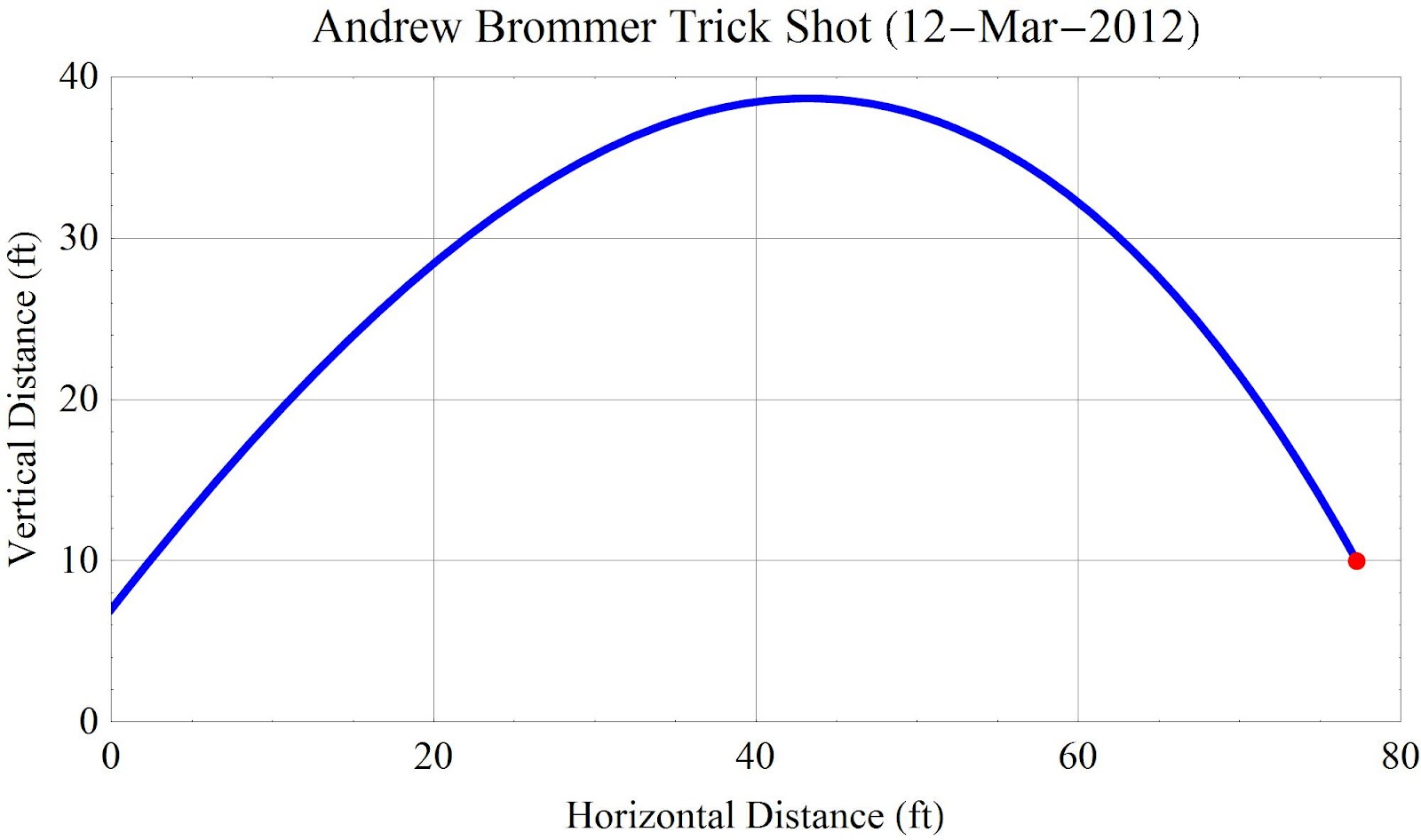
While working out at the gym this morning I saw an amazing trick shot on ESPN.  During an Iowa practice, a player wearing number 20, who ESPN tells me is Andrew Brommer (if I have the wrong player, please let me know!), hit a near-full-court backwards shot.  Click here for a YouTube video of the shot.  Once I saw the shot, I had to model it!


By my estimate, the shot went just over 77 feet (nearly 24 m) and took about 2.8 s to get from his hand to the basket.  The trajectory of the shot is shown in the image below (click on the image for a larger view of the graph).


Note that the red dot on the graph represents the basket location.  Note also that the date I use is the upload date for the video (if you know the date of the shot, please let me know!).  The basketball left Brommer's hand at about 44.5 mph (19.9 m/s) at 52° above the horizontal.  The ball reached a maximum height of 38.7 feet (11.8 m) above the court.  Upon entering the basket, the ball's speed was about 29.2 mph (13.0 m/s).


Luckily, someone filmed the shot.  There are lots of fake athletic feats online, many of them are impossible trajectories.  Given that I saw the shot on ESPN this morning, I take the shot to be real.  Certainly a once-in-a-lifetime shot!

11 March 2012

SEC TOURNAMENT CHAMPIONS!!!

THIS is why I love college sports!  My alma mater, my beloved Vanderbilt Commodores, shocked the college basketball world today with an SEC Tournament Championship win over #1-ranked University of Kentucky.  Click here for the story.  As the only private school and only top-20 academic school in the Southeastern Conference, Vandy has no hope in football and just a tad more hope than that in basketball.  We make a bowl game in football once in a blue moon, and, like this past season, it's usually because 6-6 teams are allowed to play in bowl games (crazy!).  We make an occasional run to a Sweet 16 in basketball, and that's considered a great coda to a good season.  Athletic expectations at my alma mater are not through the roof.  That is why today is so sweet.


We had to beat a less-than-stellar Ole Miss team in a hard-to-watch game (we missed TWENTY three-point shots!) to make the SEC Tournament final for the first time in 61 years.  We won the final in 1951, which is our only other SEC Tournament championship.  My parents were a year old in 1951, so it's easy to understand why a Vandy alumnus like me is raising a pint in celebration right now (I'll think about physics later!).


What makes today especially sweet is that we beat Kentucky, the undisputed top-ranked team in the land.  They had to miss TWENTY-TWO three-point shots today so that we could win by 7 points.  Kentucky is always the team-to-beat in the SEC.  They have the most national titles (7), the most SEC regular-season titles (47), and the most SEC Tournament titles (27) of any SEC team.


Vandy ended Kentucky's 24-game winning streak today.  The last and only other team to beat Kentucky this season?  My Indiana Hoosiers on 10 December 2011!

01 March 2012

Henri Lansbury's Amazing Cross-Cum Goal!

While I was celebrating Clint Dempsey's goal that gave the US its first-ever win against Italy, I noticed an even more impressive goal.  Playing for England's Under-21s, Henri Lansbury hit a spectacular cross-cum-shot from the left wing that curled into the upper-right portion of the goal while the Belgium goalkeeper Koen Casteels was futilely leaping after it.  YouTube video of the goal may be seen here.  I absolutely had to model that kick!

Lansbury's phenomenal goal took place in Riverside Stadium, which is located in Middlesbrough, England.  The pitch in that football stadium measures 115 yards by 75 yards (105 m by 69 m).  I estimate that Lansbury took the shot from nearly 28 yards (26 m) from the goal line and almost 30 yards (27 m) left of the center of the pitch.  His shot traveled approximately 40 yards (37 m) to the goal.  After I timed the shot several times, I estimate a time of flight of 2 s.

Incorporating drag and Magnus forces on the football, I determined the launch parameters needed to get the football into the upper-right portion of the goal.  The graph below shows the three-dimensional trajectory from my model of Lansbury's shot (click on the image for a larger view of the graph).


The red curve shows Lansbury's shot.  My calculated launch speed is 59.8 mph (26.8 m/s).  The blue curve in the above graph shows what the trajectory would have looked like had the football not been spinning, meaning no Magnus force.  Reaching essentially the same height, the ending point of the blue curve is about 9.7 yards (8.9 m) away from the ending point of the red curve and well to the right of the goal.  Lansbury clearly needed spin on the football to make the highlight reel!

29 February 2012

A Bouncing Basketball

Seeing a banked three-point shot from each of my alma maters last night got me thinking about bouncing basketballs.  Hold a basketball at a certain height and drop it onto the floor.  You will notice that it does not return to the same height from which it was dropped.  The ball in fact returns to a lower height because of energy lost during the collision with the floor.  There is a little energy lost to air resistance as the ball moves through air, but that loss is small compared to the energy lost during the collision.  It is actually easy to tell that energy is lost, even with your eyes closed!  The fact that you hear the ball bounce off the floor means that your ear picks up a sound wave that carries energy.  Energy is also lost to heat as the basketball's surface rubs against the floor.  The reason the ball rubs against the floor is because the ball deforms during the collision, meaning its surface spreads slightly against the floor.  Using more technical language, the ball scrunches on the floor.


A parameter we use to tell us something about energy loss is the coefficient of restitution or COR, which is the ratio of the speed just after the bounce to the speed just before the bounce (this assumes the ground does not move).  Because those speeds are sometimes hard to measure, we use heights.  A simple way to calculate COR for the dropped basketball experiment that I mentioned in the previous paragraph is COR =hh)1/2, where hi is the initial height off the floor and hf is the rebound height after the bounce.  According the NCAA rules (click here for the rule book and go to page 25), a ball dropped from a height of 6 feet (1.83 m) must rebound to a height of "not less than 49 inches" (1.24 m) and "not more than 54 inches" (1.37 m) for a college men's ball.  A college women's ball must rebound between 51 inches (1.30 m) and 56 inches (1.42 m).  That means that for a college men's ball, 0.825 < COR < 0.866, and for a college women's ball, 0.843 < COR < 0.882.  A referee can check a ball before a game by dropping it from the height of his or her head and seeing if the ball bounces to a height roughly 2/3 to 3/4 of the referee's height, which is roughly the height of the referee's mid torso.  A ball that does not satisfy the referee will need to have its air pressure changed if there is nothing wrong with the ball itself.


The amount of energy the ball keeps after the collision scales with the square of COR.  A college men's ball thus retains between 68% and 75% of its energy after colliding with the floor.  For the college women's ball, between 71% and 78% of the ball's energy is retained.  A guard dribbling the ball down the floor puts energy into the ball by doing work on it, namely by exerting a downward force on the ball while displacing the ball downward.  One must keep pushing the ball downward if one wants it to return to the same height each time because a ball with an initial downward velocity from a height of a player's hip can return to the player's hip height, whereas a ball dropped (i.e. zero initial velocity) from the player's hip height cannot.


Note that COR depends on the properties of the two surfaces involved in the collision.  One cannot simply quote a COR for a given sports ball without also specifying the surface the ball hits.  For the COR calculations I did here, I used the specifications in the rule book, which describe the ball colliding with the "playing surface."  For a ball bouncing off glass, like in the banked three-point shots I saw last night, COR is likely to be different from the value measured by dropping a ball on the playing surface.


A bank shot is even more interesting than a ball dropped onto the floor because the ball banking off the glass not only feels a force from the glass that is perpendicular to the glass surface, the ball feels a frictional force parallel to the glass surface.  That frictional force creates a torque on the ball, which changes the ball's rotation.  That means that the rebound angle the ball makes with the glass is not the same as the angle the ball made with the glass just before the ball hit the backboard.  Basketball players know this -- just watch where they bank the ball off the glass on layups.


As always, enjoy the wonderment of a sporting moment first, and then think about physics later.  After both my schools won last night, I was too happy to write about physics!

"Eric Night in America"

Okay, so I've got a silly title for this blog post, and there won't be much sports science.  Because I don't have any favorite professional teams, my rooting interests revolve around my two alma maters.  It's not every day that I get to see my two schools play back-to-back on national television. ESPN showed my 20th-ranked Hoosiers hosting 5th-ranked Michigan State at 7:00 pm, followed by my Commodores hosting 13th-ranked Florida at 9:00 pm.  Both my schools were underdogs, and both earned a double-digit victory.


Indiana, my graduate school, has beaten the #1-, #2-, and #5-ranked teams this season.  We had Michigan State's number tonight (click here for the box score), leading by 14 at the half and winning by 15.  Draymond Green for the Spartans was fantastic, scoring 29 of Michigan State's 55 points.  He should easily be the Player of the Year in the Big Ten.


Vanderbilt, my undergraduate school, joined Indiana as a school with 10 conference wins.  We shot well to knock off the highly-ranked Gators (click here for the box score) by 10 points.


My schools gave me four consecutive hours of wonderful basketball viewing tonight.  I even got to see a player from each of my schools hit a three-point bank shot.  A fun night indeed!

26 February 2012

Ronaldo's Impulsive Backheel Goal!

If you missed Cristiano Ronaldo's backheel goal to beat Rayo Vallecano today, find it on YouTube. Real Madrid's superstar's goal in the 54th minute provided the only scoring in the match.  Almost 11 m (12 yards) from the goal, and nearly aligned with the right goal post, Ronaldo backheeled the ball, which sent it rolling toward the left portion of the goal.  The ball traveled about 12.3 m (13.5 yards) from Ronaldo's heel to the goal line.  It was an amazing demonstration of athletic ability and awareness on the pitch.


After picking up my jaw upon seeing Ronaldo's great goal, the first bit of physics that entered my mind was that of impulse.  In physics we define impulse in one of two ways.  It's the change in linear momentum (mass times velocity), which is the same as the net force times the collision time.  This all comes from Newton's second law, but the details are not so important right now.  We make use of this idea a lot in everyday life.  Usually, the change in linear momentum is something we cannot control.  Imagine driving in a car and having the misfortune to slam into a tree.  Multiply your mass by the change in your velocity and that's your change in linear momentum.  You can't change that because your car's speed goes from what it was before the collision to zero after the collision.  Fortunately, there is another way to write impulse, as I noted earlier, and that is force times collision time (there is an integral here, but just think average force when I write force).  If you can do something to extend the collision time, you can reduce the force needed to stop you while you are in contact with the tree.  You already know I'm referring to an air bag.  If it can increase the collision time by, say, a factor of ten, then the force on you goes down by a factor of ten.  It's better to hit the air bag than to hit the windshield, steering wheel, or dashboard.


You can think of many other examples.  If you jump from some elevation, you bend your knees upon hitting the ground so as to extend the collision time with the ground.  Pole vaulters prefer landing pads to the ground.  Long jumpers like the sand pit instead of hard ground.  You wear a padded glove while playing baseball, again so as to extend the collision time when you catch a baseball.  Padding in American football and boxing gloves are yet more examples of ways to extend collision times.


The concept of impulse also helps us get some idea of the size of the average force when a collision takes place.  The collision time between Ronaldo's boot and the football is nearly 0.010 s.  I estimate that the ball left his boot at a speed around 13 m/s (30 mph).  It was rolling at about 1 m/s (2.2 mph) in the opposite direction just before Ronaldo kicked it.  The magnitude of the balls' velocity change was therefore about 14 m/s (31 mph).  With a 440-gram (0.97 pounds) football and a collision time of 0.010 s, the average force on the ball from Ronaldo's boot was about 616 N (138 pounds).  That might seem like a large force, but that average force lasts only ten milliseconds.


Think about Newton's laws and note that the Second Law tells us that the ball was slowing down the entire time after it left Ronaldo's boot. The Third Law tells us that Ronaldo's boot felt the same force that the ball felt during the collision.  A little padding in the back of the boot helps extend the collision time between Ronaldo's heel and his boot.  Football players are more than comfortable kicking the ball a lot harder than Ronaldo did.  Of course, Ronaldo most certainly had no complaining from his heel after such a remarkable goal!

16 February 2012

Jeremy Lin's Shot to Beat the Raptors

Two nights ago, Jeremy Lin of the New York Knicks hit a three-point shot to beat the Toronto Raptors.  Tied at 87, Lin was just behind the three-point arc and slightly right of center when he let go of the game-winner.  The ball fell through the net with just a half second remaining on the clock.  Click here for the story and video.  Lin has been in the news of late because of his great play, but also because of his great story.  It's not all the time that we see an undrafted player from Harvard making the NBA highlight reel!


I had fun analyzing Lin's shot.  After several timings, I estimate the ball's time of flight to be 1.32 s.  He looked to be just under 24 feet (7.3 m) from the basket, and let go of the ball at the top of his jump from a height above the floor of about 9.8 feet (3.0 m).  The basket sits 10 feet (3.0 m) off the floor.


To model the flight of the basketball, I included four forces.  The ball's weight of 22 oz (0.62-kg mass) is a downward force.  Because the ball displaces a volume of air equal to its own volume, the ball feels an upward buoyant force of about 0.31 oz (0.085 N), which is only 1.40% of the ball's weight.  In a direction opposite the ball's velocity is the drag force due to air resistance; the size of the drag force depends on the ball's speed.  The fourth force on the ball is the Magnus force, which is the same force that is responsible for curve balls in baseball and banana kicks in soccer.  Lin let go of the ball with backspin, so the Magnus force, which depends on the ball's speed and spin rate, has a component that is upward.  I estimate nearly three turns of the ball during its flight.


Using a computer to solve the ball's equation of motion that comes from Newton's second law, I get the trajectory in the image you see below (click on the graph for a larger image).


The ball left Lin's hand with a speed of nearly 19.9 mph (8.89 m/s) at 46.1° above the horizontal.  The ball's speed dropped to 17.5 mph (7.83 m/s) by the time it went through the basket.  Note that the ball reaches a maximum height of about 16.6 feet (5.05 m) above the court.


Below is a graph of the drag and Magnus forces on the ball as functions of time (click on the graph for a larger image).


Note that the forces in the above plot are at their minimum values when the ball is at maximum height, which is where the ball's speed is at its minimum value.  When Lin released the ball, the forces in the graph are at their maximum values because the ball's speed is greatest then.  The maximum drag force is 3.88 oz (1.08 N), which is 17.6% of the ball's weight.  The maximum Magus force is 1.30 oz (0.361 N), which is 5.90% of the ball's weight.  Note that the buoyant force, which I noted is 1.40% of the ball's weight, is nearly a quarter of the maximum Magnus force.


I hope we'll see more great shots from Jeremy Lin!

12 February 2012

Darwin Day

As I lick my wounds from seeing my beloved Vanderbilt Commodores fall to #1-ranked Kentucky last night, I reflect on the fact that on this day 203 years ago, Charles Darwin was born.  Think about how much more human beings know about how our species evolved compared to what we knew two centuries ago.  If you have only a superficial understanding of Darwin's contributions, please allow yourself to do a little reading.  If reading a book published in 1859 (On the Origin of Species) is not your cup of tea, try, for example, The Greatest Show on Earth:  The Evidence for Evolution by Richard Dawkins.  Read about the 1860 evolution debates at Oxford, which featured Thomas Huxley and Bishop Wilberforce (among others) going toe to toe.


Darwin's work remains one of the greatest contributions to not only science, but to humanity.  Evolution is not something one must "believe" or "take on faith."  The evidence for evolution is immense, and only after the countless failed efforts to falsify Darwin's theories did the scientific community begin to accept them as real descriptions of the natural world.  That is what we do in science.  We make claims based on data and evidence, and perhaps extrapolate those claims to more far-reaching theories.  Those theories are then put to the test over and over again by researchers all over the world.  A good scientific claim must be falsifiable, meaning that if evidence is found to refute that claim, and the scientific community forms a consensus that the evidence found does indeed refute the claim, the claim is tossed out.  We may not like being wrong, but we in science are not afraid of being wrong.  That is how we learn!


I find it fascinating that Abraham Lincoln was born on the exact same day as Darwin.  Deserving of the moniker, "The Great Emancipator," one could certainly argue that Lincoln was our greatest president.  Some have suggested that Lincoln was actually not the greatest emancipator born on 12 February 1809!  When one considers what Darwin gave science and humanity the world over, such a suggestion is not too far-fetched.


On a personal note, my paternal grandfather was born on 12 February 1922, which was 90 years ago today.  He died in 1994, just five days after I turned 24.  He always seemed tickled that he shared Lincoln's birthday.  Because my scientific career was only just starting near the end of his life, and because my understanding and appreciation of Darwin's work came only in my mid 20s, I never talked to him about the fact that he also shared Darwin's birthday.  I'm not sure if he knew that he did.


Tonight, I'll raise a pint to Darwin, Lincoln, and my grandfather.  I learned a great deal from all three of them.

08 February 2012

Eli's Hail Mary Against the Packers

I got a comment from someone asking about Eli Manning's Hail Mary at the end of the first half of the Giants' divisional playoff game against the Packers on 15 January 2012.  I had not modeled that pass, so I thank the person who left the comment for the suggestion.


Manning let fly his pass from the right hash mark at the Packers' 43-yard line.  Hakeem Nicks caught the ball about 5 yards deep in the end zone.  Nicks appears to have caught the ball about 20 yards to the left of the line of right hash marks.  In other words, the ball went 48 yards straight and 20 yards left, leading to a horizontal range of 52 yards (Pythagorean Theorem!).  After five timings of the flight time, I got a time of flight of 3.048 s.


Throwing the aforementioned numbers into my computer, I got a launch angle of 42.5 degrees and a launch speed of about 51.3 mph (82.6 km/hr).  The maximum height reached above Lambeau Field was around 14.5 yards (13.3 m).


Manning did not have to throw the ball as far as Brady did at the end of the Super Bowl.  Manning's pass was thrown about 88% of the speed of Brady's and at a slightly smaller angle.  Brady's pass went about 5 yards higher, too.  Credit Eli Manning for a great pass, but give equal credit to Hakeem Nicks for making a phenomenal catch.  The Giants went into the locker room up 20-10 instead of 13-10.  The play to end the half was a game-changer for sure!

07 February 2012

Two Plays to Decide Super Bowl XLVI

After studying Brady's final pass, I analyzed two more plays that helped decide Super Bowl XLVI.  Click here for the link to the article in YAHOO! SPORTS by Kristian Dyer.

06 February 2012

Tom Brady's Hail Mary

I was one of the estimated 111 million people to watch the Super Bowl last night.  That's a lot of people watching a football game, though still an order of magnitude less than the number of people that watch the FIFA World Cup every four years.  Still, the Super Bowl is the biggest game of the year in the US.  It was a great game that came down to a Hail Mary from future Hall-of-Fame New England quarterback Tom Brady.


Like everyone else, I held my breath while the ball was in the air.  I later analyzed the throw because I was curious how well Brady had thrown the pass.  Watching the replay over and over, I averaged five timings of the ball's flight time and got 3.474 seconds.  Brady appeared to let go of the ball at the New England 42-yard line; the ball was first touched about 6 yards deep in the end zone.  That means that the horizontal range of the ball was about 64 yards (58.5 meters).  Solving the equation of motion from Newton's second law, which includes air resistance, I found that Brady released the ball with a speed of 58.4 mph (94.0 km/hr) at an angle of about 45.3 degrees from the horizontal.  The ball reached a maximum height of roughly 19.5 yards (17.8 meters) above the turf.


It was a great pass, and it needed a lot of luck to be completed.  After being tipped, New England tight end Rob Gronkowski dove for the ball and looked to have a change to catch it.  But, alas, even at 6' 6" (1.98 meters) tall, Gronkowski was too late getting to the ball.  Once the ball was tipped, it began accelerating to the turf at 32 feet per second per second (9.8 meters per second per second), which is about 22 mph per second.  Gronkowski simply had too much distance to cover while the ball was making its way to the turf and giving the Giants their fourth Super Bowl win.


See Chapter 3 of my book, which focuses on Doug Flutie's famous Boston College pass to beat Miami in 1984, for more details on modeling the flight of a Hail Mary pass in football.

30 January 2012

Tennis Balls and Kinetic Energy

In the first volume of The Feynman Lectures on Physics, Richard Feynman writes, "It is important to realize that in physics today, we no knowledge of what energy is."  Though that quote comes from a book published in 1963, we are in no better position today, nearly a half century later, of knowing what energy actually is.  We use energy concepts all the time to calculate all kinds of wonderful things about nature.  We have all sorts of conceptual ideas of how to understand the application of equations for energy, but, like Feynman wrote, we really don't know what energy is.


Just this morning, I derived the "work-energy theorem" in my Classical Mechanics course, a derivation that always leaves a chill on my spine.  In short, that theorem states that the net work done on an object equals the object's kinetic energy change.  The net work done is independent of the path taken to get from starting point to ending point, and the notion of kinetic energy, or energy of motion, allows for the use of scalars instead of pesky vectors like force and displacement.  The kinetic energy is ½mv2, where m is an object's mass and v is its speed measured in some reference frame.  The beauty of the derivation is that kinetic energy is not assumed at the start.  We simply evaluate the work integral for the net force and out pops this thing ½mv2 that must be evaluated at the starting and ending points.  Only then do we call that thing "kinetic energy."


While watching yesterday's Australian Open men's final, I saw serves reaching speeds around 110 mph (177 km/hr or 49 m/s).  Given that a tennis ball weighs about two ounces, its mass is therefore about 56.7 grams (or 3.9 millislug, if you really want to use those units!).  Using SI units, a served tennis ball's kinetic energy is thus around 68.5 joules (0.016 nutritional calories or 0.065 Btu or 50.6 ft-lbs).  Of course, the ball's speed goes down on its way to the other side of the court because of air resistance, but something like 70 joules is a reasonable kinetic energy for a professionally-served tennis ball.


Now, think about what speeds some other sports balls would need to have in order to have a kinetic energy of 68.5 joules.  To keep things simple, assume all balls, including our tennis ball, have no spin.  Including spin is not hard, but I'll save a discussion of rotational kinetic energy for another blog post.  A 5-ounce (142 grams) baseball needs to travel 69.6 mph (112 km/hr or 31.1 m/s), whereas a 440-gram (0.97 pounds) Jabulani football needs to travel 39.5 mph (63.5 km/hr or 17.7 m/s).  A teenage boy can throw a baseball 70 mph and a teenage girl can kick a Jabulani football 40 mph.


The lesson here is that some kinetic energies are easier to achieve than others.  Of course, if your technique is good enough to launch a tennis serve at professional speeds, you still have to be able to control it!

29 January 2012

Six Hours of GREAT Tennis!

Okay, my title exaggerates by seven minutes the length of the Australian Open men's final.  But, Novak Djokovic's victory over Rafael Nadal is something I'll never forget.  What an epic match!  Djokovic and Nadal probably showed us the limits of what human beings can do on a tennis court.  When Djokovic broke Nadal in the 11th game of the 5th set, one had to think that Nadal was finished.  Nadal managed a break point in the 12th game, but Djokovic was not to be denied.  It was painful to see one of those men lose; Nadal was only second by the slightest of margins.  I am in awe after seeing the longest Grand Slam final.  Serbia will be celebrating for sure!


I regret not seeing Victoria Azarenka's title win over Maria Sharapova.  Though not as competitive a final as the men's final, I congratulate Azarenka for taking over the #1 spot in women's tennis.  Belarus has quite a star!


Australia gave us an amazing fortnight of tennis.  Let's hope Paris will be just as thrilling!


Look for another tennis post tomorrow.  The energetics of the ball fascinate me.

16 January 2012

Rafael Nadal and Newton's Third Law

I caught a glimpse of Rafael Nadal's opening match against Alex Kuznetsov.  The world's #2-ranked men's tennis player easily dispatched Kuznetsov in straight sets, thus kicking off Nadal's efforts to win a second Australian Open.


Newton's laws have been on my mind of late, and watching a tennis ball in flight brought the third law to the front of my mind.  One must employ Newton's second law if one wishes to model the trajectory of a tennis ball in flight.  Instead of thinking about that, I thought of the remarkable subtleties in Newton's third law.  Two objects exert forces on each other of equal magnitudes and opposite directions.  Some refer to this idea as "action/reaction," but I can't stand those terms.  When I hear "action/reaction," I think that one force is the "action," and then the other force comes along a little later as the "reaction."  That's not what happens!  One object exerts a force on another object at exactly the same time as the second object exerts a force on the first object.  One force does not precede the other.


The third law also tells us that forces, much like the Sith in Star Wars, come only in pairs.  There is no such thing as an isolated force.  Because the idea of a force requires two objects, Newton's third law pairs never appear on the same object.  Think about Nadal's powerful serve.  After the ball leaves his racket, and before it reaches the court's surface on the other side of the net, there are two forces on the ball.  One comes from the air (drag, Magnus, and buoyant forces are all air forces); the other comes from the Earth (gravity).  The third-law pair to the former force is a force on the air from the ball; the third-law pair to the latter force is a force on the Earth from the ball.  Think about that.  The ball exerts a force on the Earth of exactly the same magnitude that the Earth exerts a force on the ball!  Further, the ball pulls the Earth up while the Earth pulls the ball down.  That's true whether the ball is in flight or in Nadal's pocket.  Many people new to physics often have trouble with this idea.  Take the tennis ball's mass to be 58 grams.  That's a tad more than 2 ounces or almost 0.57 newtons.


So, do you believe that a tennis ball pulls up on the Earth with 2 ounces or 0.57 newtons of force?  To believe it, one may need to think about Newton's second law.  Sure, the tennis ball and Earth exert equal and opposite forces on each other, but we see only the effect of the Earth's force on the ball.  We don't see the Earth move!  That's because the Earth has a mass that is 100 trillion trillion times that of a tennis ball.  Drop a tennis ball, and it accelerates to the ground at about 9.8 meters per second per second (that's about 22 mph each second).  That acceleration is due to the Earth pulling on the ball with 2 ounces or 0.57 newtons of force.  The Earth hardly notices that same magnitude of force on it from the ball.  It's upward acceleration is 100 trillion trillion times smaller than that of the tennis ball.  Drop a tennis ball from a height of about 1 meter (a little more than 3 feet).  It takes about 0.45 seconds for the ball to hit the ground.  In that time, the Earth moves only about one trillion trillionth of a centimeter, which is 16 orders of magnitude smaller than the width of a hydrogen atom!  Suffice to say, the Earth couldn't care less that a tennis ball is pulling on it with 2 ounces of force!

11 January 2012

Steven Gerrard and Newton's Second Law

Liverpool beat Manchester City by the score of 1-0.  The lone goal for the Reds came via penalty kick in the 13th minute by Steven Gerrard.  Liverpool is but a game away from Wembley Stadium!  I mentioned Gerrard in an article I was invited to write for Physics Today that came out during the 2010 World Cup.  Click here for that short, general audience article (click here for the same article in Japanese).  Gerrard got his penalty kick just past Manchester City goal-keeper Joe Hart; the ball sneaked into the lower left portion of the goal.


Newton's second law popped into my head when I saw Gerrard's kick.  An object's mass multiplied by its acceleration is equal to the net, external force acting on the object.  As an equation, we might write that as ma = F.  Note that I do not write F = ma, which I choose not to do for pedagogical reasons.  As simple as that equation appears to be, it is quite subtle to work with upon meeting it the first time.  I actually wrote a general audience paper on why I write Newton's second law equation backward from what is conventional.  Click here for that article.  When I teach that equation to my students, I want to them to be aware that there is no force ma acting on the object.  I've lost count of the number of free-body diagrams that I've seen with ma forces acting on objects!


All the forces acting on an object with mass m are added as vectors and put on the side of the equation where F sits.  To analyze the motion of an association football, take the football's mass to be m, and note that a is the acceleration of the ball's center of mass.  A study of the ball's motion about its center of mass requires Newton's second law for rotations, which I won't discuss right now.  What Aristotle did not understand, and what made Newton famous, is that once the football left Gerrard's boot, Gerrard's influence on the ball came to an end.  The air (drag, Magnus, and buoyant forces are portions of the air's influence on the ball), Earth (gravity), and ground (also Earth, but I'm thinking grass now) act on the ball as it rolls toward the goal.  Gerrard could do nothing to influence the ball's motion once the ball left his boot!


Newton's genius was recognizing that a (nonzero) net, external force is required to change an object's velocity.  Aristotelian thinking leads to the belief that a (nonzero) net, external force is required to maintain an object's velocity.  That is not true!  An object may have many external forces on it and still move at a constant velocity, as long as all those external forces add (as vectors!) to zero.  The beauty of Newton's second law equation is that there is an a on the ma side of the equation, not a v.


Note that once the ball left Gerrard's boot, it had to slow down.  There was no force in the direction of motion to speed it up.  There are, however, interesting things that happen with the drag force as the ball passes through what's called the "drag crisis," but I'll save that discussion for later!  For now, congratulations to Steven Gerrard and Liverpool.  Congratulations, too, to Isaac Newton for giving us a wonderful way to think about how the sports world works.  This year we celebrate 325 years since Newton's Philosophiae Naturalis Principia Mathematica (or Principia for short) was published.

10 January 2012

Alabama and Newton's First Law

Congratulations to the University of Alabama for winning the national championship in college football.  I sat in awe last night as I watched the most dominating defensive performance I've ever seen on a college football field. To do what Alabama did to an LSU team with such an impressive season is truly remarkable.  Alabama most certainly deserves its championship.


Watching Alabama's defenders reminded me of Newton's first law, which we apply quite well to the sporting world.  An object in motion with a constant velocity, a velocity that could have zero magnitude, will remain that way unless acted upon by a net external force.  A beautiful statement, right?!?  Any sporting event provides a setting to think of Newton's laws, but I was struck last night by how many times LSU was thwarted on offense.  Click here for the box score of last night's game.  LSU had 92 yards of total offense, 39 of which came on the ground.  So many times, LSU runners were smacked with the reality of Newton's first law.  Just as they reached a constant velocity, a large, external Alabama force met them in a direction opposite their velocity.  Sometimes, that large, external Alabama force reached the LSU runner before he even achieved top speed (because the runner is accelerating just before being hit in this case, Newton's first law is not applicable).


I could obviously use any play from last night's game to talk about all three of Newton's laws.  Instead, I chose to think fondly of the first law each time an LSU runner got smacked with a large, external Alabama force.  Newton's first law can be quite subtle when we first meet it.  I'm always amused when I watch a science fiction movie that has a ship in deep space with engines ablaze.  Hey, if the ship is going a tenth the speed of light, it'll keep doing so unless acted up by a net external force, right?  No need to waste fuel by accelerating closer and closer to the speed of light!  Each Alabama smack down on an LSU runner reminded me that Aristotle had it wrong, and Newton had it right.