Tornadoes devastated parts of Dallas, Texas yesterday. After viewing some truly terrible video footage on televisions at the gym this morning, I can only hope that there are no fatalities. Seeing the tornado footage got me thinking about various forces due to the air. Air forces play crucial roles in many sports, especially those in which balls are bandied about. The drag force is usually the dominate component of the air's net force on a ball in flight, though the Magnus force is strong enough to alter trajectories and give us wonderful banana kicks in soccer and curveballs in baseball, just to name two examples.
The forces involved with the motion of air in a tornado are certainly much larger than the force a ball feels from the air. But what is actually pushing on the air itself to make a tornado? The physics behind tornado formation is quite complicated and not really what I wish to devote space to here. Suffice to note that air accelerates when pressure differences exist. Formation of a tornado is greatly dependent on local weather conditions. What is not a key player in the formation of tornadoes is the Coriolis effect.
The Coriolis effect is named after the French scientist Gaspard-Gustave de Coriolis (1792-1843). The effect arises when one tries to apply Newton's laws in a reference frame, called "noninertial," where those laws are not valid. A good rule of thumb for identifying a noninertial reference frame is to note if the frame is accelerating with respect to some previously defined inertial frame. If we imagine the stars in the sky as being "fixed" over the time we are doing an experiment, then the distant stars sit in an inertial reference frame (they certainly move, and they accelerate, but over the time of our experiments, we don't see much change!). Usually the Earth is taken to be an inertial frame in which we apply Newton's laws of motion. Locally, noninertial effects are not that noticeable. But take a large mass of air in a hurricane or a cannon shell that travels over tens of kilometers and the fact that the Earth is noninertial comes into play. The Earth turns on its axis, which means that objects on Earth's surface are constantly accelerating. Recall that acceleration is the time rate of change of velocity, which is a vector that has both magnitude and direction. Objects on the surface of a spinning object must be accelerating because velocity vectors are constantly changing directions.
It turns out that tornadoes involve air masses that are much too small to be concerned with the Coriolis effect. If one wishes to calculate the influence of the Earth's rotation on projected objects, one must solve some rather fun equations. What pops out of those equations is that objects projected in the northern hemisphere, regardless of velocity direction, are deflected to the right because of the Coriolis effect. The deflection is to the left in the southern hemisphere. When one analyzes air flows and pressure differences, the Coriolis effect explains why hurricanes in the northern hemisphere rotate counterclockwise as seen from above. Hurricanes rotate clockwise as seen from above in the southern hemisphere. Please note that if tornadoes comprise masses too small for the Coriolis effect to play a noticeable role, toilet water is even less effected. Don't believe the nonsense about the Coriolis effect causing toilet water to spin a certain way when flushed!
If the Coriolis effect won't bother a tornado, it certainly won't bother most of the sporting events we watch. Did you see Kobe Bryant's great three-point shot last night? Click here for video. I calculate that the rightward deflection of Kobe's shot was about half a millimeter, which is about two hundredths of an inch. Now, the ball was definitely bouncing around the rim after Kobe shot it. But I don't think half a millimeter was the difference between going in and staying out. The Coriolis effect is essentially unseen in the sports world.
There were a couple of things that happened yesterday that had not been seen before. The first was that Baylor University women's team became the first men's or women's team to go 40-0 as they won their second national title (the first coming in 2005). Baylor's Brittney Griner was sure fun to watch. Besides all the hype surrounding her becoming the second woman to dunk in the tournament, she possesses a great inside game that is fun to watch.
The other previously unseen thing that happened in the sports world last night was the great Lionel Messi scoring his 14th goal for Barcelona this year in Champions League competition. Messi scored on two penalty kicks against AC Milan. What seems almost unfair is that Barcelona not only has the services of Lionel Messi but Andres Iniesta, too. Iniesta had a great goal in the 53rd minute of the match.

04 April 2012

22 March 2012
Amazing behind-the-back pass!
Have you seen the amazing behind-the-back pass made by Danilo Gallinari? I analyzed the pass for YAHOO! SPORTS. Click here for the link to the article by Kristian Dyer.
21 March 2012
Lionel Messi -- Stability and Greatness!
By now the sports world has learned that Lionel Messi became the all-time leading scorer for Futbol Club Barcelona. Messi earned the record in style with a hat trick last night against Granada. Click here for an ESPN story and video highlights of Messi's three goals. There is some great physics behind what Messi does on a football pitch! All players are, of course, constrained by the laws of physics, but Messi is a fantastic player to watch when trying to understand the crucial role played by physics in goal scoring. I have no idea how much physics Messi understands, but it is clear watching him that he has assimilated physics principles into his technique. It is also clear that Messi has great teammates who are often able to get him the ball in what looks to be the perfect place.
Consider the first goal at the 17-minute mark. On the above video, look at the footage near the 0:10 mark. Messi was waving for the ball with his right hand just before entering the penalty area. The ball reached him perfectly at about 5 yards (4.6 m) into the box. Because Messi was right of the goal, he rotated his body counterclockwise (as seen from above). When his left boot made contact with the ball, Messi was leaning slightly to the right, thus maintaining stability by ensuring that a net torque did not rotate him toward the ground. Messi's left foot crossed in front of his body as he struck the ball, but his rightward lean kept him stable. The ball struck the post on the left side of the goal and ricocheted in for the goal that tied the Barcelona record.
For the goal that set Messi apart from all Barcelona players, go to the 0:31 mark of the video where the game was in the 67th minute (was Messi offside?). Messi was around 10 yards (9.1 m) from the goal. Watch what happened when Messi received the ball with his left boot. To maintain stability while his left leg was raised, Messi leaned back slightly, and you will note that both his arms were raised out from his sides. By having his arms out, Messi was able to control any possible side-to-side motion that might have resulted from an unbalanced torque while his left boot dealt with the ball. By moving his arms out, Messi increased his moment of inertia, which increased the torque required to tip him over. If you freeze the video just right, it almost looks like Messi was doing the crane from Karate Kid, though his arms were not raised as high as Daniel's were (click here if you don't know what I mean). Messi then booted a slow rainbow kick over the goal keeper, who was only about 3.5 yards (3.2 m) in front of Messi at the time, that sneaked into the left side of the goal.
For the goal at the 86-minute mark that earned Messi the hat trick, go to the 0:55 mark of the video. Messi received a perfect pass 9 yards (8.2 m) from the goal line and 6 yards (5.5 m) right of the right goal post. Mess first made contact with the pass with his left boot while his left leg was extended well in front of his body, a necessary move to arrest the motion of the pass. Again, phenomenal stability was maintained because Messi's right leg was extended well behind his body. He thus made sure there was not net torque to cause him to slip. Messi then did his magic by eluding the goal keeper and getting to nearly the deepest part of the rightmost portion of the goal area. Having rotated his body counterclockwise (as seen from above), Messi was able to gently guide the ball into the goal with his left boot moving in front of his right leg. Just at the point of striking the ball, you will see Messi's lower legs almost making an X shape with his knees slightly outward. Once again, complete stability!
There are many great players, past and present, that one may use to learn about the physics of great football. For me, however, Lionel Messi is the paragon I use to see wonderful physics in the beautiful game.
Consider the first goal at the 17-minute mark. On the above video, look at the footage near the 0:10 mark. Messi was waving for the ball with his right hand just before entering the penalty area. The ball reached him perfectly at about 5 yards (4.6 m) into the box. Because Messi was right of the goal, he rotated his body counterclockwise (as seen from above). When his left boot made contact with the ball, Messi was leaning slightly to the right, thus maintaining stability by ensuring that a net torque did not rotate him toward the ground. Messi's left foot crossed in front of his body as he struck the ball, but his rightward lean kept him stable. The ball struck the post on the left side of the goal and ricocheted in for the goal that tied the Barcelona record.
For the goal that set Messi apart from all Barcelona players, go to the 0:31 mark of the video where the game was in the 67th minute (was Messi offside?). Messi was around 10 yards (9.1 m) from the goal. Watch what happened when Messi received the ball with his left boot. To maintain stability while his left leg was raised, Messi leaned back slightly, and you will note that both his arms were raised out from his sides. By having his arms out, Messi was able to control any possible side-to-side motion that might have resulted from an unbalanced torque while his left boot dealt with the ball. By moving his arms out, Messi increased his moment of inertia, which increased the torque required to tip him over. If you freeze the video just right, it almost looks like Messi was doing the crane from Karate Kid, though his arms were not raised as high as Daniel's were (click here if you don't know what I mean). Messi then booted a slow rainbow kick over the goal keeper, who was only about 3.5 yards (3.2 m) in front of Messi at the time, that sneaked into the left side of the goal.

For the goal at the 86-minute mark that earned Messi the hat trick, go to the 0:55 mark of the video. Messi received a perfect pass 9 yards (8.2 m) from the goal line and 6 yards (5.5 m) right of the right goal post. Mess first made contact with the pass with his left boot while his left leg was extended well in front of his body, a necessary move to arrest the motion of the pass. Again, phenomenal stability was maintained because Messi's right leg was extended well behind his body. He thus made sure there was not net torque to cause him to slip. Messi then did his magic by eluding the goal keeper and getting to nearly the deepest part of the rightmost portion of the goal area. Having rotated his body counterclockwise (as seen from above), Messi was able to gently guide the ball into the goal with his left boot moving in front of his right leg. Just at the point of striking the ball, you will see Messi's lower legs almost making an X shape with his knees slightly outward. Once again, complete stability!
There are many great players, past and present, that one may use to learn about the physics of great football. For me, however, Lionel Messi is the paragon I use to see wonderful physics in the beautiful game.
18 March 2012
Bitter Sweet Basketball -- It's Still Just a Game
There is a very good reason that "fan" is (probably) short for "fanatic" when referring to a sports fan. We fans are often delusional when it comes to our sports teams. In some rare instances, that delusion turns violent, leading to tragic results, like the recent Port Said Stadium disaster in Egypt. Most of the time, however, sports delusion manifests itself in a "faith" that our favorite team can, and should, win almost every game it plays. One definition offered by Webster for "faith" is the firm or unquestioning belief in something for which there is no proof. Those wonderful italic words make it clear that science is not faith-based. They also make it clear why we sports fans have too much faith when it comes to our teams. I number myself among delusional sports fans!
I did not pick Vanderbilt to beat Wisconsin when I filled out my March Madness bracket. In a quiet, rational moment while contemplating "Vanderbilt" or "Wisconsin," I entered the better team in my bracket. Of course, pessimism is a part of many sports fans' psyche. We simultaneously have faith in our team's chances while picking against our team because we actually think that lowering expectations will help us accept a potential loss just a tad better.
Watching yesterday's loss to Wisconsin, I knew that my team was simply not quite as good as the other team. Still, in those final minutes, I believed that anything could happen and that my Commodores could pull out the win. Unlike that game Cinderella wins against a better team that they probably could not repeat if the two teams played ten more times, my Vanderbilt Commodores simply lost to a better team in the Wisconsin Badgers. We had a few more turnovers, and when the game was on the line, they hit a three they had no business hitting and we missed an open look at a three. Ballgame. We lost by three. Sure I was disgusted that we lost. Sure I wondered "what if?" about a hundred times while replaying the game in my mind in the span of about ten seconds. But faith came to an end when the proof of which team was better got played out right in front of me.
After a few minutes of anguish, my sensibilities returned. Hey, no shame in losing to a better team, right? I suppose my benign delusion was okay for a few minutes -- loving my alma maters is part of what makes my life fun. Congratulations to Wisconsin for advancing to the Sweet Sixteen. Congratulations, too, to my Vanderbilt Commodores. For an alum like me, I'm proud of my team. We won 25 games this year, plus we get to put a shiny SEC Tournament Champions trophy in our case in Nashville. A great season!
What's funny is that while the delusional part of my mind that focuses on Vanderbilt was returning to reality, the part of my mind colored cream and crimson was still frantic about Indiana's chances of beating Virginia Commonwealth University. One gut-wrenching game bled into another! Indiana shot well during the game, but we turned the ball over so much that I began to wonder if one of our called plays was "step out of bounds!" There was a stretch in the second half when I simply couldn't believe what I was seeing. All I could see was my team's mistakes. It simply wasn't registering in my mind that my team's carelessness was being offset by VCU's protracted shooting drought. As much screaming as I was doing after each lost IU possession, it was only in the final minute or two that I realized that we actually had a chance to win the game.
Much like Vandy's loss to Wisconsin, the end of the IU win over VCU came down to which team could make a final play. We hit our open shot; they missed their open shot, which would've won them the game had it fallen. After their shot missed and all zeroes showed on the game clock, my strongest memory is hearing my older daughter running into another room to tell her mom, "Daddy is jumping up and down in front of the TV!" In the span of about an hour, I had experienced the low of watching my team come up just short and the high of watching my team squeak out a win it probably shouldn't have gotten. Such is life for a sports fan!
So Indiana moves on to the Sweet Sixteen for the first time in ten years. Kentucky is waiting for us. Kentucky, the #1-overall seed in the tournament. Kentucky, the team we beat on our floor with the shot of the year (so far). It's a relatively quiet Sunday morning right now and I know that Indiana has no chance to beat Kentucky next Friday in the Georgia Dome. Such craziness to think that we can! Oh, but wait, I feel some good faith-based delusion sinking into my head. Ten years ago, Indiana was a #5 seed, just one seed worse than this year. We faced the #1-overall seed that year in the Sweet Sixteen. We beat Duke by the IU-famous score of 74-73 (think 1987 title game for another great 74-73 win), which got us marching to the title game before losing to Maryland (in a completely unwatchable game, though not as bad as last year's final). Hey, it can happen again, right?
A little delusion is fun. Let's not forget, though, that the sports teams we love so much play games. At the end of the day, it's still just a game. As crazy as I get watching my teams in tight games, my passion for science is much stronger. My love for my family and friends is even stronger. Of the 68 teams to make the Dance, 67 will lose their final game. The fact that almost all teams in a given sport lose their final game of tournament play means that the overwhelming majority of sports fans are disappointed to some degree once the season ends. Put sports disappointment in its proper perspective and enjoy all the other wonderful aspects of life. For me, seeing my younger daughter's excited face this morning when I wished her a happy 6th birthday put all my sports highs and lows where they should be -- way, way down on my priority list.
I did not pick Vanderbilt to beat Wisconsin when I filled out my March Madness bracket. In a quiet, rational moment while contemplating "Vanderbilt" or "Wisconsin," I entered the better team in my bracket. Of course, pessimism is a part of many sports fans' psyche. We simultaneously have faith in our team's chances while picking against our team because we actually think that lowering expectations will help us accept a potential loss just a tad better.
Watching yesterday's loss to Wisconsin, I knew that my team was simply not quite as good as the other team. Still, in those final minutes, I believed that anything could happen and that my Commodores could pull out the win. Unlike that game Cinderella wins against a better team that they probably could not repeat if the two teams played ten more times, my Vanderbilt Commodores simply lost to a better team in the Wisconsin Badgers. We had a few more turnovers, and when the game was on the line, they hit a three they had no business hitting and we missed an open look at a three. Ballgame. We lost by three. Sure I was disgusted that we lost. Sure I wondered "what if?" about a hundred times while replaying the game in my mind in the span of about ten seconds. But faith came to an end when the proof of which team was better got played out right in front of me.
After a few minutes of anguish, my sensibilities returned. Hey, no shame in losing to a better team, right? I suppose my benign delusion was okay for a few minutes -- loving my alma maters is part of what makes my life fun. Congratulations to Wisconsin for advancing to the Sweet Sixteen. Congratulations, too, to my Vanderbilt Commodores. For an alum like me, I'm proud of my team. We won 25 games this year, plus we get to put a shiny SEC Tournament Champions trophy in our case in Nashville. A great season!
What's funny is that while the delusional part of my mind that focuses on Vanderbilt was returning to reality, the part of my mind colored cream and crimson was still frantic about Indiana's chances of beating Virginia Commonwealth University. One gut-wrenching game bled into another! Indiana shot well during the game, but we turned the ball over so much that I began to wonder if one of our called plays was "step out of bounds!" There was a stretch in the second half when I simply couldn't believe what I was seeing. All I could see was my team's mistakes. It simply wasn't registering in my mind that my team's carelessness was being offset by VCU's protracted shooting drought. As much screaming as I was doing after each lost IU possession, it was only in the final minute or two that I realized that we actually had a chance to win the game.
Much like Vandy's loss to Wisconsin, the end of the IU win over VCU came down to which team could make a final play. We hit our open shot; they missed their open shot, which would've won them the game had it fallen. After their shot missed and all zeroes showed on the game clock, my strongest memory is hearing my older daughter running into another room to tell her mom, "Daddy is jumping up and down in front of the TV!" In the span of about an hour, I had experienced the low of watching my team come up just short and the high of watching my team squeak out a win it probably shouldn't have gotten. Such is life for a sports fan!
So Indiana moves on to the Sweet Sixteen for the first time in ten years. Kentucky is waiting for us. Kentucky, the #1-overall seed in the tournament. Kentucky, the team we beat on our floor with the shot of the year (so far). It's a relatively quiet Sunday morning right now and I know that Indiana has no chance to beat Kentucky next Friday in the Georgia Dome. Such craziness to think that we can! Oh, but wait, I feel some good faith-based delusion sinking into my head. Ten years ago, Indiana was a #5 seed, just one seed worse than this year. We faced the #1-overall seed that year in the Sweet Sixteen. We beat Duke by the IU-famous score of 74-73 (think 1987 title game for another great 74-73 win), which got us marching to the title game before losing to Maryland (in a completely unwatchable game, though not as bad as last year's final). Hey, it can happen again, right?
A little delusion is fun. Let's not forget, though, that the sports teams we love so much play games. At the end of the day, it's still just a game. As crazy as I get watching my teams in tight games, my passion for science is much stronger. My love for my family and friends is even stronger. Of the 68 teams to make the Dance, 67 will lose their final game. The fact that almost all teams in a given sport lose their final game of tournament play means that the overwhelming majority of sports fans are disappointed to some degree once the season ends. Put sports disappointment in its proper perspective and enjoy all the other wonderful aspects of life. For me, seeing my younger daughter's excited face this morning when I wished her a happy 6th birthday put all my sports highs and lows where they should be -- way, way down on my priority list.
17 March 2012
100 International Centuries!
My recent sports obsession has been with the NCAA men's basketball tournament -- the Big Dance. Both my alma maters, Vanderbilt and Indiana, are still alive; both are playing this evening for a shot at the Sweet Sixteen. Many sports fans in the US, including me, were thrilled last night as Norfolk State and Lehigh pulled off monumental upsets.
Amidst all the basketball excitement, I couldn't help but notice the sports news coming out of the cricket world. India's great Sachin Tendulkar scored his 100th international century yesterday against Bangladesh. If you are reading this and know nothing about cricket, take a few minutes and read a story or two online about Tendulkar's achievement. India has nearly four times the population of the US, meaning there are a lot more people celebrating what Tendulkar has done compared to those of us who live and die with each basket during March Madness.
I was introduced to cricket in my mid 20s. The aerodynamics of the cricket ball is of great interest to me, but I only began following the sport once the 2011 Cricket World Cup got underway. India won its second World Cup last summer after beating Sri Lanka. Working with my colleague, Chin Liyanage, who is from Sri Lanka, and researching with Aakar Verma, an Indian student who came to Lynchburg College last summer to work with me, have given me opportunities to broaden my understanding of cricket. Whether or not you get into the big numbers in sports, and even if cricket is not so familiar to you, Sachin Tendulkar is a name a fan of sports should know.
Is Sachin Tendulkar the greatest batsman that cricket has ever seen? I invite those more familiar with cricket's storied history than I am to answer that question either by commenting here or by e-mailing me.
Amidst all the basketball excitement, I couldn't help but notice the sports news coming out of the cricket world. India's great Sachin Tendulkar scored his 100th international century yesterday against Bangladesh. If you are reading this and know nothing about cricket, take a few minutes and read a story or two online about Tendulkar's achievement. India has nearly four times the population of the US, meaning there are a lot more people celebrating what Tendulkar has done compared to those of us who live and die with each basket during March Madness.
I was introduced to cricket in my mid 20s. The aerodynamics of the cricket ball is of great interest to me, but I only began following the sport once the 2011 Cricket World Cup got underway. India won its second World Cup last summer after beating Sri Lanka. Working with my colleague, Chin Liyanage, who is from Sri Lanka, and researching with Aakar Verma, an Indian student who came to Lynchburg College last summer to work with me, have given me opportunities to broaden my understanding of cricket. Whether or not you get into the big numbers in sports, and even if cricket is not so familiar to you, Sachin Tendulkar is a name a fan of sports should know.
Is Sachin Tendulkar the greatest batsman that cricket has ever seen? I invite those more familiar with cricket's storied history than I am to answer that question either by commenting here or by e-mailing me.
14 March 2012
Amazing trick shot!
While working out at the gym this morning I saw an amazing trick shot on ESPN. During an Iowa practice, a player wearing number 20, who ESPN tells me is Andrew Brommer (if I have the wrong player, please let me know!), hit a near-full-court backwards shot. Click here for a YouTube video of the shot. Once I saw the shot, I had to model it!
By my estimate, the shot went just over 77 feet (nearly 24 m) and took about 2.8 s to get from his hand to the basket. The trajectory of the shot is shown in the image below (click on the image for a larger view of the graph).

Note that the red dot on the graph represents the basket location. Note also that the date I use is the upload date for the video (if you know the date of the shot, please let me know!). The basketball left Brommer's hand at about 44.5 mph (19.9 m/s) at 52° above the horizontal. The ball reached a maximum height of 38.7 feet (11.8 m) above the court. Upon entering the basket, the ball's speed was about 29.2 mph (13.0 m/s).
Luckily, someone filmed the shot. There are lots of fake athletic feats online, many of them are impossible trajectories. Given that I saw the shot on ESPN this morning, I take the shot to be real. Certainly a once-in-a-lifetime shot!
By my estimate, the shot went just over 77 feet (nearly 24 m) and took about 2.8 s to get from his hand to the basket. The trajectory of the shot is shown in the image below (click on the image for a larger view of the graph).
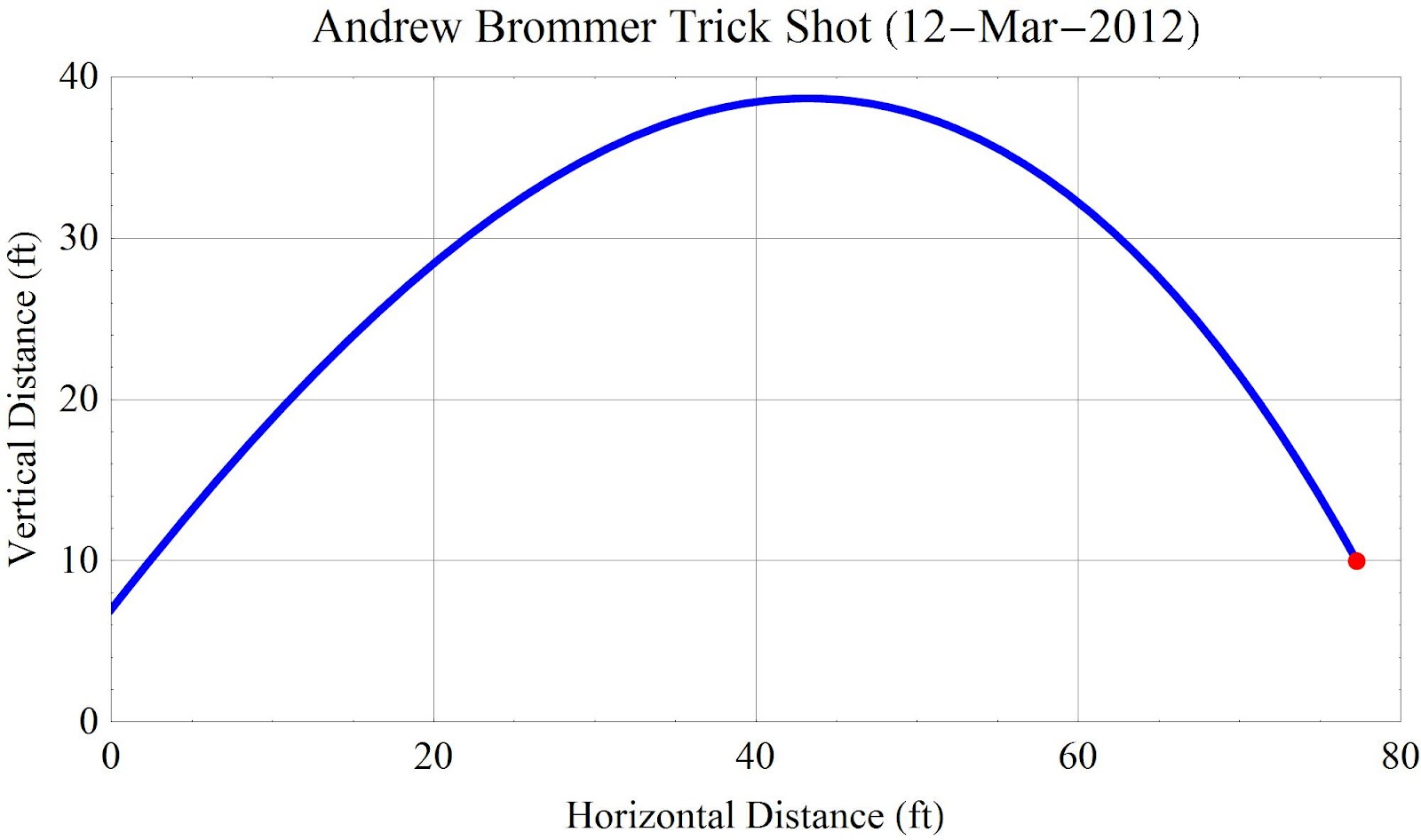
Note that the red dot on the graph represents the basket location. Note also that the date I use is the upload date for the video (if you know the date of the shot, please let me know!). The basketball left Brommer's hand at about 44.5 mph (19.9 m/s) at 52° above the horizontal. The ball reached a maximum height of 38.7 feet (11.8 m) above the court. Upon entering the basket, the ball's speed was about 29.2 mph (13.0 m/s).
Luckily, someone filmed the shot. There are lots of fake athletic feats online, many of them are impossible trajectories. Given that I saw the shot on ESPN this morning, I take the shot to be real. Certainly a once-in-a-lifetime shot!
11 March 2012
SEC TOURNAMENT CHAMPIONS!!!
THIS is why I love college sports! My alma mater, my beloved Vanderbilt Commodores, shocked the college basketball world today with an SEC Tournament Championship win over #1-ranked University of Kentucky. Click here for the story. As the only private school and only top-20 academic school in the Southeastern Conference, Vandy has no hope in football and just a tad more hope than that in basketball. We make a bowl game in football once in a blue moon, and, like this past season, it's usually because 6-6 teams are allowed to play in bowl games (crazy!). We make an occasional run to a Sweet 16 in basketball, and that's considered a great coda to a good season. Athletic expectations at my alma mater are not through the roof. That is why today is so sweet.
We had to beat a less-than-stellar Ole Miss team in a hard-to-watch game (we missed TWENTY three-point shots!) to make the SEC Tournament final for the first time in 61 years. We won the final in 1951, which is our only other SEC Tournament championship. My parents were a year old in 1951, so it's easy to understand why a Vandy alumnus like me is raising a pint in celebration right now (I'll think about physics later!).
What makes today especially sweet is that we beat Kentucky, the undisputed top-ranked team in the land. They had to miss TWENTY-TWO three-point shots today so that we could win by 7 points. Kentucky is always the team-to-beat in the SEC. They have the most national titles (7), the most SEC regular-season titles (47), and the most SEC Tournament titles (27) of any SEC team.
Vandy ended Kentucky's 24-game winning streak today. The last and only other team to beat Kentucky this season? My Indiana Hoosiers on 10 December 2011!
We had to beat a less-than-stellar Ole Miss team in a hard-to-watch game (we missed TWENTY three-point shots!) to make the SEC Tournament final for the first time in 61 years. We won the final in 1951, which is our only other SEC Tournament championship. My parents were a year old in 1951, so it's easy to understand why a Vandy alumnus like me is raising a pint in celebration right now (I'll think about physics later!).
What makes today especially sweet is that we beat Kentucky, the undisputed top-ranked team in the land. They had to miss TWENTY-TWO three-point shots today so that we could win by 7 points. Kentucky is always the team-to-beat in the SEC. They have the most national titles (7), the most SEC regular-season titles (47), and the most SEC Tournament titles (27) of any SEC team.
Vandy ended Kentucky's 24-game winning streak today. The last and only other team to beat Kentucky this season? My Indiana Hoosiers on 10 December 2011!
01 March 2012
Henri Lansbury's Amazing Cross-Cum Goal!
While I was celebrating Clint Dempsey's goal that gave the US its first-ever win against Italy, I noticed an even more impressive goal. Playing for England's Under-21s, Henri Lansbury hit a spectacular cross-cum-shot from the left wing that curled into the upper-right portion of the goal while the Belgium goalkeeper Koen Casteels was futilely leaping after it. YouTube video of the goal may be seen here. I absolutely had to model that kick!
Lansbury's phenomenal goal took place in Riverside Stadium, which is located in Middlesbrough, England. The pitch in that football stadium measures 115 yards by 75 yards (105 m by 69 m). I estimate that Lansbury took the shot from nearly 28 yards (26 m) from the goal line and almost 30 yards (27 m) left of the center of the pitch. His shot traveled approximately 40 yards (37 m) to the goal. After I timed the shot several times, I estimate a time of flight of 2 s.
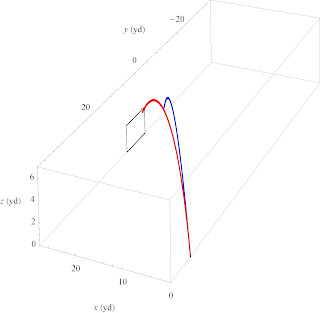
Incorporating drag and Magnus forces on the football, I determined the launch parameters needed to get the football into the upper-right portion of the goal. The graph below shows the three-dimensional trajectory from my model of Lansbury's shot (click on the image for a larger view of the graph).

The red curve shows Lansbury's shot. My calculated launch speed is 59.8 mph (26.8 m/s). The blue curve in the above graph shows what the trajectory would have looked like had the football not been spinning, meaning no Magnus force. Reaching essentially the same height, the ending point of the blue curve is about 9.7 yards (8.9 m) away from the ending point of the red curve and well to the right of the goal. Lansbury clearly needed spin on the football to make the highlight reel!
29 February 2012
A Bouncing Basketball
Seeing a banked three-point shot from each of my alma maters last night got me thinking about bouncing basketballs. Hold a basketball at a certain height and drop it onto the floor. You will notice that it does not return to the same height from which it was dropped. The ball in fact returns to a lower height because of energy lost during the collision with the floor. There is a little energy lost to air resistance as the ball moves through air, but that loss is small compared to the energy lost during the collision. It is actually easy to tell that energy is lost, even with your eyes closed! The fact that you hear the ball bounce off the floor means that your ear picks up a sound wave that carries energy. Energy is also lost to heat as the basketball's surface rubs against the floor. The reason the ball rubs against the floor is because the ball deforms during the collision, meaning its surface spreads slightly against the floor. Using more technical language, the ball scrunches on the floor.
A parameter we use to tell us something about energy loss is the coefficient of restitution or COR, which is the ratio of the speed just after the bounce to the speed just before the bounce (this assumes the ground does not move). Because those speeds are sometimes hard to measure, we use heights. A simple way to calculate COR for the dropped basketball experiment that I mentioned in the previous paragraph is COR =( hf / hi )1/2, where hi is the initial height off the floor and hf is the rebound height after the bounce. According the NCAA rules (click here for the rule book and go to page 25), a ball dropped from a height of 6 feet (1.83 m) must rebound to a height of "not less than 49 inches" (1.24 m) and "not more than 54 inches" (1.37 m) for a college men's ball. A college women's ball must rebound between 51 inches (1.30 m) and 56 inches (1.42 m). That means that for a college men's ball, 0.825 < COR < 0.866, and for a college women's ball, 0.843 < COR < 0.882. A referee can check a ball before a game by dropping it from the height of his or her head and seeing if the ball bounces to a height roughly 2/3 to 3/4 of the referee's height, which is roughly the height of the referee's mid torso. A ball that does not satisfy the referee will need to have its air pressure changed if there is nothing wrong with the ball itself.
The amount of energy the ball keeps after the collision scales with the square of COR. A college men's ball thus retains between 68% and 75% of its energy after colliding with the floor. For the college women's ball, between 71% and 78% of the ball's energy is retained. A guard dribbling the ball down the floor puts energy into the ball by doing work on it, namely by exerting a downward force on the ball while displacing the ball downward. One must keep pushing the ball downward if one wants it to return to the same height each time because a ball with an initial downward velocity from a height of a player's hip can return to the player's hip height, whereas a ball dropped (i.e. zero initial velocity) from the player's hip height cannot.
Note that COR depends on the properties of the two surfaces involved in the collision. One cannot simply quote a COR for a given sports ball without also specifying the surface the ball hits. For the COR calculations I did here, I used the specifications in the rule book, which describe the ball colliding with the "playing surface." For a ball bouncing off glass, like in the banked three-point shots I saw last night, COR is likely to be different from the value measured by dropping a ball on the playing surface.
A bank shot is even more interesting than a ball dropped onto the floor because the ball banking off the glass not only feels a force from the glass that is perpendicular to the glass surface, the ball feels a frictional force parallel to the glass surface. That frictional force creates a torque on the ball, which changes the ball's rotation. That means that the rebound angle the ball makes with the glass is not the same as the angle the ball made with the glass just before the ball hit the backboard. Basketball players know this -- just watch where they bank the ball off the glass on layups.
As always, enjoy the wonderment of a sporting moment first, and then think about physics later. After both my schools won last night, I was too happy to write about physics!
A parameter we use to tell us something about energy loss is the coefficient of restitution or COR, which is the ratio of the speed just after the bounce to the speed just before the bounce (this assumes the ground does not move). Because those speeds are sometimes hard to measure, we use heights. A simple way to calculate COR for the dropped basketball experiment that I mentioned in the previous paragraph is COR =( hf / hi )1/2, where hi is the initial height off the floor and hf is the rebound height after the bounce. According the NCAA rules (click here for the rule book and go to page 25), a ball dropped from a height of 6 feet (1.83 m) must rebound to a height of "not less than 49 inches" (1.24 m) and "not more than 54 inches" (1.37 m) for a college men's ball. A college women's ball must rebound between 51 inches (1.30 m) and 56 inches (1.42 m). That means that for a college men's ball, 0.825 < COR < 0.866, and for a college women's ball, 0.843 < COR < 0.882. A referee can check a ball before a game by dropping it from the height of his or her head and seeing if the ball bounces to a height roughly 2/3 to 3/4 of the referee's height, which is roughly the height of the referee's mid torso. A ball that does not satisfy the referee will need to have its air pressure changed if there is nothing wrong with the ball itself.
The amount of energy the ball keeps after the collision scales with the square of COR. A college men's ball thus retains between 68% and 75% of its energy after colliding with the floor. For the college women's ball, between 71% and 78% of the ball's energy is retained. A guard dribbling the ball down the floor puts energy into the ball by doing work on it, namely by exerting a downward force on the ball while displacing the ball downward. One must keep pushing the ball downward if one wants it to return to the same height each time because a ball with an initial downward velocity from a height of a player's hip can return to the player's hip height, whereas a ball dropped (i.e. zero initial velocity) from the player's hip height cannot.
Note that COR depends on the properties of the two surfaces involved in the collision. One cannot simply quote a COR for a given sports ball without also specifying the surface the ball hits. For the COR calculations I did here, I used the specifications in the rule book, which describe the ball colliding with the "playing surface." For a ball bouncing off glass, like in the banked three-point shots I saw last night, COR is likely to be different from the value measured by dropping a ball on the playing surface.
A bank shot is even more interesting than a ball dropped onto the floor because the ball banking off the glass not only feels a force from the glass that is perpendicular to the glass surface, the ball feels a frictional force parallel to the glass surface. That frictional force creates a torque on the ball, which changes the ball's rotation. That means that the rebound angle the ball makes with the glass is not the same as the angle the ball made with the glass just before the ball hit the backboard. Basketball players know this -- just watch where they bank the ball off the glass on layups.
As always, enjoy the wonderment of a sporting moment first, and then think about physics later. After both my schools won last night, I was too happy to write about physics!
"Eric Night in America"
Okay, so I've got a silly title for this blog post, and there won't be much sports science. Because I don't have any favorite professional teams, my rooting interests revolve around my two alma maters. It's not every day that I get to see my two schools play back-to-back on national television. ESPN showed my 20th-ranked Hoosiers hosting 5th-ranked Michigan State at 7:00 pm, followed by my Commodores hosting 13th-ranked Florida at 9:00 pm. Both my schools were underdogs, and both earned a double-digit victory.
Indiana, my graduate school, has beaten the #1-, #2-, and #5-ranked teams this season. We had Michigan State's number tonight (click here for the box score), leading by 14 at the half and winning by 15. Draymond Green for the Spartans was fantastic, scoring 29 of Michigan State's 55 points. He should easily be the Player of the Year in the Big Ten.
Vanderbilt, my undergraduate school, joined Indiana as a school with 10 conference wins. We shot well to knock off the highly-ranked Gators (click here for the box score) by 10 points.
My schools gave me four consecutive hours of wonderful basketball viewing tonight. I even got to see a player from each of my schools hit a three-point bank shot. A fun night indeed!
Indiana, my graduate school, has beaten the #1-, #2-, and #5-ranked teams this season. We had Michigan State's number tonight (click here for the box score), leading by 14 at the half and winning by 15. Draymond Green for the Spartans was fantastic, scoring 29 of Michigan State's 55 points. He should easily be the Player of the Year in the Big Ten.
Vanderbilt, my undergraduate school, joined Indiana as a school with 10 conference wins. We shot well to knock off the highly-ranked Gators (click here for the box score) by 10 points.
My schools gave me four consecutive hours of wonderful basketball viewing tonight. I even got to see a player from each of my schools hit a three-point bank shot. A fun night indeed!
26 February 2012
Ronaldo's Impulsive Backheel Goal!
If you missed Cristiano Ronaldo's backheel goal to beat Rayo Vallecano today, find it on YouTube. Real Madrid's superstar's goal in the 54th minute provided the only scoring in the match. Almost 11 m (12 yards) from the goal, and nearly aligned with the right goal post, Ronaldo backheeled the ball, which sent it rolling toward the left portion of the goal. The ball traveled about 12.3 m (13.5 yards) from Ronaldo's heel to the goal line. It was an amazing demonstration of athletic ability and awareness on the pitch.
After picking up my jaw upon seeing Ronaldo's great goal, the first bit of physics that entered my mind was that of impulse. In physics we define impulse in one of two ways. It's the change in linear momentum (mass times velocity), which is the same as the net force times the collision time. This all comes from Newton's second law, but the details are not so important right now. We make use of this idea a lot in everyday life. Usually, the change in linear momentum is something we cannot control. Imagine driving in a car and having the misfortune to slam into a tree. Multiply your mass by the change in your velocity and that's your change in linear momentum. You can't change that because your car's speed goes from what it was before the collision to zero after the collision. Fortunately, there is another way to write impulse, as I noted earlier, and that is force times collision time (there is an integral here, but just think average force when I write force). If you can do something to extend the collision time, you can reduce the force needed to stop you while you are in contact with the tree. You already know I'm referring to an air bag. If it can increase the collision time by, say, a factor of ten, then the force on you goes down by a factor of ten. It's better to hit the air bag than to hit the windshield, steering wheel, or dashboard.
You can think of many other examples. If you jump from some elevation, you bend your knees upon hitting the ground so as to extend the collision time with the ground. Pole vaulters prefer landing pads to the ground. Long jumpers like the sand pit instead of hard ground. You wear a padded glove while playing baseball, again so as to extend the collision time when you catch a baseball. Padding in American football and boxing gloves are yet more examples of ways to extend collision times.
The concept of impulse also helps us get some idea of the size of the average force when a collision takes place. The collision time between Ronaldo's boot and the football is nearly 0.010 s. I estimate that the ball left his boot at a speed around 13 m/s (30 mph). It was rolling at about 1 m/s (2.2 mph) in the opposite direction just before Ronaldo kicked it. The magnitude of the balls' velocity change was therefore about 14 m/s (31 mph). With a 440-gram (0.97 pounds) football and a collision time of 0.010 s, the average force on the ball from Ronaldo's boot was about 616 N (138 pounds). That might seem like a large force, but that average force lasts only ten milliseconds.
Think about Newton's laws and note that the Second Law tells us that the ball was slowing down the entire time after it left Ronaldo's boot. The Third Law tells us that Ronaldo's boot felt the same force that the ball felt during the collision. A little padding in the back of the boot helps extend the collision time between Ronaldo's heel and his boot. Football players are more than comfortable kicking the ball a lot harder than Ronaldo did. Of course, Ronaldo most certainly had no complaining from his heel after such a remarkable goal!
After picking up my jaw upon seeing Ronaldo's great goal, the first bit of physics that entered my mind was that of impulse. In physics we define impulse in one of two ways. It's the change in linear momentum (mass times velocity), which is the same as the net force times the collision time. This all comes from Newton's second law, but the details are not so important right now. We make use of this idea a lot in everyday life. Usually, the change in linear momentum is something we cannot control. Imagine driving in a car and having the misfortune to slam into a tree. Multiply your mass by the change in your velocity and that's your change in linear momentum. You can't change that because your car's speed goes from what it was before the collision to zero after the collision. Fortunately, there is another way to write impulse, as I noted earlier, and that is force times collision time (there is an integral here, but just think average force when I write force). If you can do something to extend the collision time, you can reduce the force needed to stop you while you are in contact with the tree. You already know I'm referring to an air bag. If it can increase the collision time by, say, a factor of ten, then the force on you goes down by a factor of ten. It's better to hit the air bag than to hit the windshield, steering wheel, or dashboard.
You can think of many other examples. If you jump from some elevation, you bend your knees upon hitting the ground so as to extend the collision time with the ground. Pole vaulters prefer landing pads to the ground. Long jumpers like the sand pit instead of hard ground. You wear a padded glove while playing baseball, again so as to extend the collision time when you catch a baseball. Padding in American football and boxing gloves are yet more examples of ways to extend collision times.
The concept of impulse also helps us get some idea of the size of the average force when a collision takes place. The collision time between Ronaldo's boot and the football is nearly 0.010 s. I estimate that the ball left his boot at a speed around 13 m/s (30 mph). It was rolling at about 1 m/s (2.2 mph) in the opposite direction just before Ronaldo kicked it. The magnitude of the balls' velocity change was therefore about 14 m/s (31 mph). With a 440-gram (0.97 pounds) football and a collision time of 0.010 s, the average force on the ball from Ronaldo's boot was about 616 N (138 pounds). That might seem like a large force, but that average force lasts only ten milliseconds.
Think about Newton's laws and note that the Second Law tells us that the ball was slowing down the entire time after it left Ronaldo's boot. The Third Law tells us that Ronaldo's boot felt the same force that the ball felt during the collision. A little padding in the back of the boot helps extend the collision time between Ronaldo's heel and his boot. Football players are more than comfortable kicking the ball a lot harder than Ronaldo did. Of course, Ronaldo most certainly had no complaining from his heel after such a remarkable goal!
16 February 2012
Jeremy Lin's Shot to Beat the Raptors
Two nights ago, Jeremy Lin of the New York Knicks hit a three-point shot to beat the Toronto Raptors. Tied at 87, Lin was just behind the three-point arc and slightly right of center when he let go of the game-winner. The ball fell through the net with just a half second remaining on the clock. Click here for the story and video. Lin has been in the news of late because of his great play, but also because of his great story. It's not all the time that we see an undrafted player from Harvard making the NBA highlight reel!
I had fun analyzing Lin's shot. After several timings, I estimate the ball's time of flight to be 1.32 s. He looked to be just under 24 feet (7.3 m) from the basket, and let go of the ball at the top of his jump from a height above the floor of about 9.8 feet (3.0 m). The basket sits 10 feet (3.0 m) off the floor.
To model the flight of the basketball, I included four forces. The ball's weight of 22 oz (0.62-kg mass) is a downward force. Because the ball displaces a volume of air equal to its own volume, the ball feels an upward buoyant force of about 0.31 oz (0.085 N), which is only 1.40% of the ball's weight. In a direction opposite the ball's velocity is the drag force due to air resistance; the size of the drag force depends on the ball's speed. The fourth force on the ball is the Magnus force, which is the same force that is responsible for curve balls in baseball and banana kicks in soccer. Lin let go of the ball with backspin, so the Magnus force, which depends on the ball's speed and spin rate, has a component that is upward. I estimate nearly three turns of the ball during its flight.
Using a computer to solve the ball's equation of motion that comes from Newton's second law, I get the trajectory in the image you see below (click on the graph for a larger image).

The ball left Lin's hand with a speed of nearly 19.9 mph (8.89 m/s) at 46.1° above the horizontal. The ball's speed dropped to 17.5 mph (7.83 m/s) by the time it went through the basket. Note that the ball reaches a maximum height of about 16.6 feet (5.05 m) above the court.
Below is a graph of the drag and Magnus forces on the ball as functions of time (click on the graph for a larger image).

Note that the forces in the above plot are at their minimum values when the ball is at maximum height, which is where the ball's speed is at its minimum value. When Lin released the ball, the forces in the graph are at their maximum values because the ball's speed is greatest then. The maximum drag force is 3.88 oz (1.08 N), which is 17.6% of the ball's weight. The maximum Magus force is 1.30 oz (0.361 N), which is 5.90% of the ball's weight. Note that the buoyant force, which I noted is 1.40% of the ball's weight, is nearly a quarter of the maximum Magnus force.
I hope we'll see more great shots from Jeremy Lin!
I had fun analyzing Lin's shot. After several timings, I estimate the ball's time of flight to be 1.32 s. He looked to be just under 24 feet (7.3 m) from the basket, and let go of the ball at the top of his jump from a height above the floor of about 9.8 feet (3.0 m). The basket sits 10 feet (3.0 m) off the floor.
To model the flight of the basketball, I included four forces. The ball's weight of 22 oz (0.62-kg mass) is a downward force. Because the ball displaces a volume of air equal to its own volume, the ball feels an upward buoyant force of about 0.31 oz (0.085 N), which is only 1.40% of the ball's weight. In a direction opposite the ball's velocity is the drag force due to air resistance; the size of the drag force depends on the ball's speed. The fourth force on the ball is the Magnus force, which is the same force that is responsible for curve balls in baseball and banana kicks in soccer. Lin let go of the ball with backspin, so the Magnus force, which depends on the ball's speed and spin rate, has a component that is upward. I estimate nearly three turns of the ball during its flight.
Using a computer to solve the ball's equation of motion that comes from Newton's second law, I get the trajectory in the image you see below (click on the graph for a larger image).

The ball left Lin's hand with a speed of nearly 19.9 mph (8.89 m/s) at 46.1° above the horizontal. The ball's speed dropped to 17.5 mph (7.83 m/s) by the time it went through the basket. Note that the ball reaches a maximum height of about 16.6 feet (5.05 m) above the court.
Below is a graph of the drag and Magnus forces on the ball as functions of time (click on the graph for a larger image).

Note that the forces in the above plot are at their minimum values when the ball is at maximum height, which is where the ball's speed is at its minimum value. When Lin released the ball, the forces in the graph are at their maximum values because the ball's speed is greatest then. The maximum drag force is 3.88 oz (1.08 N), which is 17.6% of the ball's weight. The maximum Magus force is 1.30 oz (0.361 N), which is 5.90% of the ball's weight. Note that the buoyant force, which I noted is 1.40% of the ball's weight, is nearly a quarter of the maximum Magnus force.
I hope we'll see more great shots from Jeremy Lin!
12 February 2012
Darwin Day
As I lick my wounds from seeing my beloved Vanderbilt Commodores fall to #1-ranked Kentucky last night, I reflect on the fact that on this day 203 years ago, Charles Darwin was born. Think about how much more human beings know about how our species evolved compared to what we knew two centuries ago. If you have only a superficial understanding of Darwin's contributions, please allow yourself to do a little reading. If reading a book published in 1859 (On the Origin of Species) is not your cup of tea, try, for example, The Greatest Show on Earth: The Evidence for Evolution by Richard Dawkins. Read about the 1860 evolution debates at Oxford, which featured Thomas Huxley and Bishop Wilberforce (among others) going toe to toe.
Darwin's work remains one of the greatest contributions to not only science, but to humanity. Evolution is not something one must "believe" or "take on faith." The evidence for evolution is immense, and only after the countless failed efforts to falsify Darwin's theories did the scientific community begin to accept them as real descriptions of the natural world. That is what we do in science. We make claims based on data and evidence, and perhaps extrapolate those claims to more far-reaching theories. Those theories are then put to the test over and over again by researchers all over the world. A good scientific claim must be falsifiable, meaning that if evidence is found to refute that claim, and the scientific community forms a consensus that the evidence found does indeed refute the claim, the claim is tossed out. We may not like being wrong, but we in science are not afraid of being wrong. That is how we learn!
I find it fascinating that Abraham Lincoln was born on the exact same day as Darwin. Deserving of the moniker, "The Great Emancipator," one could certainly argue that Lincoln was our greatest president. Some have suggested that Lincoln was actually not the greatest emancipator born on 12 February 1809! When one considers what Darwin gave science and humanity the world over, such a suggestion is not too far-fetched.
On a personal note, my paternal grandfather was born on 12 February 1922, which was 90 years ago today. He died in 1994, just five days after I turned 24. He always seemed tickled that he shared Lincoln's birthday. Because my scientific career was only just starting near the end of his life, and because my understanding and appreciation of Darwin's work came only in my mid 20s, I never talked to him about the fact that he also shared Darwin's birthday. I'm not sure if he knew that he did.
Tonight, I'll raise a pint to Darwin, Lincoln, and my grandfather. I learned a great deal from all three of them.
Darwin's work remains one of the greatest contributions to not only science, but to humanity. Evolution is not something one must "believe" or "take on faith." The evidence for evolution is immense, and only after the countless failed efforts to falsify Darwin's theories did the scientific community begin to accept them as real descriptions of the natural world. That is what we do in science. We make claims based on data and evidence, and perhaps extrapolate those claims to more far-reaching theories. Those theories are then put to the test over and over again by researchers all over the world. A good scientific claim must be falsifiable, meaning that if evidence is found to refute that claim, and the scientific community forms a consensus that the evidence found does indeed refute the claim, the claim is tossed out. We may not like being wrong, but we in science are not afraid of being wrong. That is how we learn!
I find it fascinating that Abraham Lincoln was born on the exact same day as Darwin. Deserving of the moniker, "The Great Emancipator," one could certainly argue that Lincoln was our greatest president. Some have suggested that Lincoln was actually not the greatest emancipator born on 12 February 1809! When one considers what Darwin gave science and humanity the world over, such a suggestion is not too far-fetched.
On a personal note, my paternal grandfather was born on 12 February 1922, which was 90 years ago today. He died in 1994, just five days after I turned 24. He always seemed tickled that he shared Lincoln's birthday. Because my scientific career was only just starting near the end of his life, and because my understanding and appreciation of Darwin's work came only in my mid 20s, I never talked to him about the fact that he also shared Darwin's birthday. I'm not sure if he knew that he did.
Tonight, I'll raise a pint to Darwin, Lincoln, and my grandfather. I learned a great deal from all three of them.
08 February 2012
Eli's Hail Mary Against the Packers
I got a comment from someone asking about Eli Manning's Hail Mary at the end of the first half of the Giants' divisional playoff game against the Packers on 15 January 2012. I had not modeled that pass, so I thank the person who left the comment for the suggestion.
Manning let fly his pass from the right hash mark at the Packers' 43-yard line. Hakeem Nicks caught the ball about 5 yards deep in the end zone. Nicks appears to have caught the ball about 20 yards to the left of the line of right hash marks. In other words, the ball went 48 yards straight and 20 yards left, leading to a horizontal range of 52 yards (Pythagorean Theorem!). After five timings of the flight time, I got a time of flight of 3.048 s.
Throwing the aforementioned numbers into my computer, I got a launch angle of 42.5 degrees and a launch speed of about 51.3 mph (82.6 km/hr). The maximum height reached above Lambeau Field was around 14.5 yards (13.3 m).
Manning did not have to throw the ball as far as Brady did at the end of the Super Bowl. Manning's pass was thrown about 88% of the speed of Brady's and at a slightly smaller angle. Brady's pass went about 5 yards higher, too. Credit Eli Manning for a great pass, but give equal credit to Hakeem Nicks for making a phenomenal catch. The Giants went into the locker room up 20-10 instead of 13-10. The play to end the half was a game-changer for sure!
Manning let fly his pass from the right hash mark at the Packers' 43-yard line. Hakeem Nicks caught the ball about 5 yards deep in the end zone. Nicks appears to have caught the ball about 20 yards to the left of the line of right hash marks. In other words, the ball went 48 yards straight and 20 yards left, leading to a horizontal range of 52 yards (Pythagorean Theorem!). After five timings of the flight time, I got a time of flight of 3.048 s.
Throwing the aforementioned numbers into my computer, I got a launch angle of 42.5 degrees and a launch speed of about 51.3 mph (82.6 km/hr). The maximum height reached above Lambeau Field was around 14.5 yards (13.3 m).
Manning did not have to throw the ball as far as Brady did at the end of the Super Bowl. Manning's pass was thrown about 88% of the speed of Brady's and at a slightly smaller angle. Brady's pass went about 5 yards higher, too. Credit Eli Manning for a great pass, but give equal credit to Hakeem Nicks for making a phenomenal catch. The Giants went into the locker room up 20-10 instead of 13-10. The play to end the half was a game-changer for sure!
07 February 2012
Two Plays to Decide Super Bowl XLVI
After studying Brady's final pass, I analyzed two more plays that helped decide Super Bowl XLVI. Click here for the link to the article in YAHOO! SPORTS by Kristian Dyer.
06 February 2012
Tom Brady's Hail Mary
I was one of the estimated 111 million people to watch the Super Bowl last night. That's a lot of people watching a football game, though still an order of magnitude less than the number of people that watch the FIFA World Cup every four years. Still, the Super Bowl is the biggest game of the year in the US. It was a great game that came down to a Hail Mary from future Hall-of-Fame New England quarterback Tom Brady.
Like everyone else, I held my breath while the ball was in the air. I later analyzed the throw because I was curious how well Brady had thrown the pass. Watching the replay over and over, I averaged five timings of the ball's flight time and got 3.474 seconds. Brady appeared to let go of the ball at the New England 42-yard line; the ball was first touched about 6 yards deep in the end zone. That means that the horizontal range of the ball was about 64 yards (58.5 meters). Solving the equation of motion from Newton's second law, which includes air resistance, I found that Brady released the ball with a speed of 58.4 mph (94.0 km/hr) at an angle of about 45.3 degrees from the horizontal. The ball reached a maximum height of roughly 19.5 yards (17.8 meters) above the turf.
It was a great pass, and it needed a lot of luck to be completed. After being tipped, New England tight end Rob Gronkowski dove for the ball and looked to have a change to catch it. But, alas, even at 6' 6" (1.98 meters) tall, Gronkowski was too late getting to the ball. Once the ball was tipped, it began accelerating to the turf at 32 feet per second per second (9.8 meters per second per second), which is about 22 mph per second. Gronkowski simply had too much distance to cover while the ball was making its way to the turf and giving the Giants their fourth Super Bowl win.
See Chapter 3 of my book, which focuses on Doug Flutie's famous Boston College pass to beat Miami in 1984, for more details on modeling the flight of a Hail Mary pass in football.
Like everyone else, I held my breath while the ball was in the air. I later analyzed the throw because I was curious how well Brady had thrown the pass. Watching the replay over and over, I averaged five timings of the ball's flight time and got 3.474 seconds. Brady appeared to let go of the ball at the New England 42-yard line; the ball was first touched about 6 yards deep in the end zone. That means that the horizontal range of the ball was about 64 yards (58.5 meters). Solving the equation of motion from Newton's second law, which includes air resistance, I found that Brady released the ball with a speed of 58.4 mph (94.0 km/hr) at an angle of about 45.3 degrees from the horizontal. The ball reached a maximum height of roughly 19.5 yards (17.8 meters) above the turf.
It was a great pass, and it needed a lot of luck to be completed. After being tipped, New England tight end Rob Gronkowski dove for the ball and looked to have a change to catch it. But, alas, even at 6' 6" (1.98 meters) tall, Gronkowski was too late getting to the ball. Once the ball was tipped, it began accelerating to the turf at 32 feet per second per second (9.8 meters per second per second), which is about 22 mph per second. Gronkowski simply had too much distance to cover while the ball was making its way to the turf and giving the Giants their fourth Super Bowl win.
See Chapter 3 of my book, which focuses on Doug Flutie's famous Boston College pass to beat Miami in 1984, for more details on modeling the flight of a Hail Mary pass in football.
30 January 2012
Tennis Balls and Kinetic Energy
In the first volume of The Feynman Lectures on Physics, Richard Feynman writes, "It is important to realize that in physics today, we no knowledge of what energy is." Though that quote comes from a book published in 1963, we are in no better position today, nearly a half century later, of knowing what energy actually is. We use energy concepts all the time to calculate all kinds of wonderful things about nature. We have all sorts of conceptual ideas of how to understand the application of equations for energy, but, like Feynman wrote, we really don't know what energy is.
Just this morning, I derived the "work-energy theorem" in my Classical Mechanics course, a derivation that always leaves a chill on my spine. In short, that theorem states that the net work done on an object equals the object's kinetic energy change. The net work done is independent of the path taken to get from starting point to ending point, and the notion of kinetic energy, or energy of motion, allows for the use of scalars instead of pesky vectors like force and displacement. The kinetic energy is ½mv2, where m is an object's mass and v is its speed measured in some reference frame. The beauty of the derivation is that kinetic energy is not assumed at the start. We simply evaluate the work integral for the net force and out pops this thing ½mv2 that must be evaluated at the starting and ending points. Only then do we call that thing "kinetic energy."
While watching yesterday's Australian Open men's final, I saw serves reaching speeds around 110 mph (177 km/hr or 49 m/s). Given that a tennis ball weighs about two ounces, its mass is therefore about 56.7 grams (or 3.9 millislug, if you really want to use those units!). Using SI units, a served tennis ball's kinetic energy is thus around 68.5 joules (0.016 nutritional calories or 0.065 Btu or 50.6 ft-lbs). Of course, the ball's speed goes down on its way to the other side of the court because of air resistance, but something like 70 joules is a reasonable kinetic energy for a professionally-served tennis ball.
Now, think about what speeds some other sports balls would need to have in order to have a kinetic energy of 68.5 joules. To keep things simple, assume all balls, including our tennis ball, have no spin. Including spin is not hard, but I'll save a discussion of rotational kinetic energy for another blog post. A 5-ounce (142 grams) baseball needs to travel 69.6 mph (112 km/hr or 31.1 m/s), whereas a 440-gram (0.97 pounds) Jabulani football needs to travel 39.5 mph (63.5 km/hr or 17.7 m/s). A teenage boy can throw a baseball 70 mph and a teenage girl can kick a Jabulani football 40 mph.
The lesson here is that some kinetic energies are easier to achieve than others. Of course, if your technique is good enough to launch a tennis serve at professional speeds, you still have to be able to control it!
Just this morning, I derived the "work-energy theorem" in my Classical Mechanics course, a derivation that always leaves a chill on my spine. In short, that theorem states that the net work done on an object equals the object's kinetic energy change. The net work done is independent of the path taken to get from starting point to ending point, and the notion of kinetic energy, or energy of motion, allows for the use of scalars instead of pesky vectors like force and displacement. The kinetic energy is ½mv2, where m is an object's mass and v is its speed measured in some reference frame. The beauty of the derivation is that kinetic energy is not assumed at the start. We simply evaluate the work integral for the net force and out pops this thing ½mv2 that must be evaluated at the starting and ending points. Only then do we call that thing "kinetic energy."
While watching yesterday's Australian Open men's final, I saw serves reaching speeds around 110 mph (177 km/hr or 49 m/s). Given that a tennis ball weighs about two ounces, its mass is therefore about 56.7 grams (or 3.9 millislug, if you really want to use those units!). Using SI units, a served tennis ball's kinetic energy is thus around 68.5 joules (0.016 nutritional calories or 0.065 Btu or 50.6 ft-lbs). Of course, the ball's speed goes down on its way to the other side of the court because of air resistance, but something like 70 joules is a reasonable kinetic energy for a professionally-served tennis ball.
Now, think about what speeds some other sports balls would need to have in order to have a kinetic energy of 68.5 joules. To keep things simple, assume all balls, including our tennis ball, have no spin. Including spin is not hard, but I'll save a discussion of rotational kinetic energy for another blog post. A 5-ounce (142 grams) baseball needs to travel 69.6 mph (112 km/hr or 31.1 m/s), whereas a 440-gram (0.97 pounds) Jabulani football needs to travel 39.5 mph (63.5 km/hr or 17.7 m/s). A teenage boy can throw a baseball 70 mph and a teenage girl can kick a Jabulani football 40 mph.
The lesson here is that some kinetic energies are easier to achieve than others. Of course, if your technique is good enough to launch a tennis serve at professional speeds, you still have to be able to control it!
29 January 2012
Six Hours of GREAT Tennis!
Okay, my title exaggerates by seven minutes the length of the Australian Open men's final. But, Novak Djokovic's victory over Rafael Nadal is something I'll never forget. What an epic match! Djokovic and Nadal probably showed us the limits of what human beings can do on a tennis court. When Djokovic broke Nadal in the 11th game of the 5th set, one had to think that Nadal was finished. Nadal managed a break point in the 12th game, but Djokovic was not to be denied. It was painful to see one of those men lose; Nadal was only second by the slightest of margins. I am in awe after seeing the longest Grand Slam final. Serbia will be celebrating for sure!
I regret not seeing Victoria Azarenka's title win over Maria Sharapova. Though not as competitive a final as the men's final, I congratulate Azarenka for taking over the #1 spot in women's tennis. Belarus has quite a star!
Australia gave us an amazing fortnight of tennis. Let's hope Paris will be just as thrilling!
Look for another tennis post tomorrow. The energetics of the ball fascinate me.
I regret not seeing Victoria Azarenka's title win over Maria Sharapova. Though not as competitive a final as the men's final, I congratulate Azarenka for taking over the #1 spot in women's tennis. Belarus has quite a star!
Australia gave us an amazing fortnight of tennis. Let's hope Paris will be just as thrilling!
Look for another tennis post tomorrow. The energetics of the ball fascinate me.
16 January 2012
Rafael Nadal and Newton's Third Law
I caught a glimpse of Rafael Nadal's opening match against Alex Kuznetsov. The world's #2-ranked men's tennis player easily dispatched Kuznetsov in straight sets, thus kicking off Nadal's efforts to win a second Australian Open.
Newton's laws have been on my mind of late, and watching a tennis ball in flight brought the third law to the front of my mind. One must employ Newton's second law if one wishes to model the trajectory of a tennis ball in flight. Instead of thinking about that, I thought of the remarkable subtleties in Newton's third law. Two objects exert forces on each other of equal magnitudes and opposite directions. Some refer to this idea as "action/reaction," but I can't stand those terms. When I hear "action/reaction," I think that one force is the "action," and then the other force comes along a little later as the "reaction." That's not what happens! One object exerts a force on another object at exactly the same time as the second object exerts a force on the first object. One force does not precede the other.
The third law also tells us that forces, much like the Sith in Star Wars, come only in pairs. There is no such thing as an isolated force. Because the idea of a force requires two objects, Newton's third law pairs never appear on the same object. Think about Nadal's powerful serve. After the ball leaves his racket, and before it reaches the court's surface on the other side of the net, there are two forces on the ball. One comes from the air (drag, Magnus, and buoyant forces are all air forces); the other comes from the Earth (gravity). The third-law pair to the former force is a force on the air from the ball; the third-law pair to the latter force is a force on the Earth from the ball. Think about that. The ball exerts a force on the Earth of exactly the same magnitude that the Earth exerts a force on the ball! Further, the ball pulls the Earth up while the Earth pulls the ball down. That's true whether the ball is in flight or in Nadal's pocket. Many people new to physics often have trouble with this idea. Take the tennis ball's mass to be 58 grams. That's a tad more than 2 ounces or almost 0.57 newtons.
So, do you believe that a tennis ball pulls up on the Earth with 2 ounces or 0.57 newtons of force? To believe it, one may need to think about Newton's second law. Sure, the tennis ball and Earth exert equal and opposite forces on each other, but we see only the effect of the Earth's force on the ball. We don't see the Earth move! That's because the Earth has a mass that is 100 trillion trillion times that of a tennis ball. Drop a tennis ball, and it accelerates to the ground at about 9.8 meters per second per second (that's about 22 mph each second). That acceleration is due to the Earth pulling on the ball with 2 ounces or 0.57 newtons of force. The Earth hardly notices that same magnitude of force on it from the ball. It's upward acceleration is 100 trillion trillion times smaller than that of the tennis ball. Drop a tennis ball from a height of about 1 meter (a little more than 3 feet). It takes about 0.45 seconds for the ball to hit the ground. In that time, the Earth moves only about one trillion trillionth of a centimeter, which is 16 orders of magnitude smaller than the width of a hydrogen atom! Suffice to say, the Earth couldn't care less that a tennis ball is pulling on it with 2 ounces of force!
Newton's laws have been on my mind of late, and watching a tennis ball in flight brought the third law to the front of my mind. One must employ Newton's second law if one wishes to model the trajectory of a tennis ball in flight. Instead of thinking about that, I thought of the remarkable subtleties in Newton's third law. Two objects exert forces on each other of equal magnitudes and opposite directions. Some refer to this idea as "action/reaction," but I can't stand those terms. When I hear "action/reaction," I think that one force is the "action," and then the other force comes along a little later as the "reaction." That's not what happens! One object exerts a force on another object at exactly the same time as the second object exerts a force on the first object. One force does not precede the other.
The third law also tells us that forces, much like the Sith in Star Wars, come only in pairs. There is no such thing as an isolated force. Because the idea of a force requires two objects, Newton's third law pairs never appear on the same object. Think about Nadal's powerful serve. After the ball leaves his racket, and before it reaches the court's surface on the other side of the net, there are two forces on the ball. One comes from the air (drag, Magnus, and buoyant forces are all air forces); the other comes from the Earth (gravity). The third-law pair to the former force is a force on the air from the ball; the third-law pair to the latter force is a force on the Earth from the ball. Think about that. The ball exerts a force on the Earth of exactly the same magnitude that the Earth exerts a force on the ball! Further, the ball pulls the Earth up while the Earth pulls the ball down. That's true whether the ball is in flight or in Nadal's pocket. Many people new to physics often have trouble with this idea. Take the tennis ball's mass to be 58 grams. That's a tad more than 2 ounces or almost 0.57 newtons.
So, do you believe that a tennis ball pulls up on the Earth with 2 ounces or 0.57 newtons of force? To believe it, one may need to think about Newton's second law. Sure, the tennis ball and Earth exert equal and opposite forces on each other, but we see only the effect of the Earth's force on the ball. We don't see the Earth move! That's because the Earth has a mass that is 100 trillion trillion times that of a tennis ball. Drop a tennis ball, and it accelerates to the ground at about 9.8 meters per second per second (that's about 22 mph each second). That acceleration is due to the Earth pulling on the ball with 2 ounces or 0.57 newtons of force. The Earth hardly notices that same magnitude of force on it from the ball. It's upward acceleration is 100 trillion trillion times smaller than that of the tennis ball. Drop a tennis ball from a height of about 1 meter (a little more than 3 feet). It takes about 0.45 seconds for the ball to hit the ground. In that time, the Earth moves only about one trillion trillionth of a centimeter, which is 16 orders of magnitude smaller than the width of a hydrogen atom! Suffice to say, the Earth couldn't care less that a tennis ball is pulling on it with 2 ounces of force!
11 January 2012
Steven Gerrard and Newton's Second Law
Liverpool beat Manchester City by the score of 1-0. The lone goal for the Reds came via penalty kick in the 13th minute by Steven Gerrard. Liverpool is but a game away from Wembley Stadium! I mentioned Gerrard in an article I was invited to write for Physics Today that came out during the 2010 World Cup. Click here for that short, general audience article (click here for the same article in Japanese). Gerrard got his penalty kick just past Manchester City goal-keeper Joe Hart; the ball sneaked into the lower left portion of the goal.
Newton's second law popped into my head when I saw Gerrard's kick. An object's mass multiplied by its acceleration is equal to the net, external force acting on the object. As an equation, we might write that as ma = F. Note that I do not write F = ma, which I choose not to do for pedagogical reasons. As simple as that equation appears to be, it is quite subtle to work with upon meeting it the first time. I actually wrote a general audience paper on why I write Newton's second law equation backward from what is conventional. Click here for that article. When I teach that equation to my students, I want to them to be aware that there is no force ma acting on the object. I've lost count of the number of free-body diagrams that I've seen with ma forces acting on objects!
All the forces acting on an object with mass m are added as vectors and put on the side of the equation where F sits. To analyze the motion of an association football, take the football's mass to be m, and note that a is the acceleration of the ball's center of mass. A study of the ball's motion about its center of mass requires Newton's second law for rotations, which I won't discuss right now. What Aristotle did not understand, and what made Newton famous, is that once the football left Gerrard's boot, Gerrard's influence on the ball came to an end. The air (drag, Magnus, and buoyant forces are portions of the air's influence on the ball), Earth (gravity), and ground (also Earth, but I'm thinking grass now) act on the ball as it rolls toward the goal. Gerrard could do nothing to influence the ball's motion once the ball left his boot!
Newton's genius was recognizing that a (nonzero) net, external force is required to change an object's velocity. Aristotelian thinking leads to the belief that a (nonzero) net, external force is required to maintain an object's velocity. That is not true! An object may have many external forces on it and still move at a constant velocity, as long as all those external forces add (as vectors!) to zero. The beauty of Newton's second law equation is that there is an a on the ma side of the equation, not a v.
Note that once the ball left Gerrard's boot, it had to slow down. There was no force in the direction of motion to speed it up. There are, however, interesting things that happen with the drag force as the ball passes through what's called the "drag crisis," but I'll save that discussion for later! For now, congratulations to Steven Gerrard and Liverpool. Congratulations, too, to Isaac Newton for giving us a wonderful way to think about how the sports world works. This year we celebrate 325 years since Newton's Philosophiae Naturalis Principia Mathematica (or Principia for short) was published.
Newton's second law popped into my head when I saw Gerrard's kick. An object's mass multiplied by its acceleration is equal to the net, external force acting on the object. As an equation, we might write that as ma = F. Note that I do not write F = ma, which I choose not to do for pedagogical reasons. As simple as that equation appears to be, it is quite subtle to work with upon meeting it the first time. I actually wrote a general audience paper on why I write Newton's second law equation backward from what is conventional. Click here for that article. When I teach that equation to my students, I want to them to be aware that there is no force ma acting on the object. I've lost count of the number of free-body diagrams that I've seen with ma forces acting on objects!
All the forces acting on an object with mass m are added as vectors and put on the side of the equation where F sits. To analyze the motion of an association football, take the football's mass to be m, and note that a is the acceleration of the ball's center of mass. A study of the ball's motion about its center of mass requires Newton's second law for rotations, which I won't discuss right now. What Aristotle did not understand, and what made Newton famous, is that once the football left Gerrard's boot, Gerrard's influence on the ball came to an end. The air (drag, Magnus, and buoyant forces are portions of the air's influence on the ball), Earth (gravity), and ground (also Earth, but I'm thinking grass now) act on the ball as it rolls toward the goal. Gerrard could do nothing to influence the ball's motion once the ball left his boot!
Newton's genius was recognizing that a (nonzero) net, external force is required to change an object's velocity. Aristotelian thinking leads to the belief that a (nonzero) net, external force is required to maintain an object's velocity. That is not true! An object may have many external forces on it and still move at a constant velocity, as long as all those external forces add (as vectors!) to zero. The beauty of Newton's second law equation is that there is an a on the ma side of the equation, not a v.
Note that once the ball left Gerrard's boot, it had to slow down. There was no force in the direction of motion to speed it up. There are, however, interesting things that happen with the drag force as the ball passes through what's called the "drag crisis," but I'll save that discussion for later! For now, congratulations to Steven Gerrard and Liverpool. Congratulations, too, to Isaac Newton for giving us a wonderful way to think about how the sports world works. This year we celebrate 325 years since Newton's Philosophiae Naturalis Principia Mathematica (or Principia for short) was published.
10 January 2012
Alabama and Newton's First Law
Congratulations to the University of Alabama for winning the national championship in college football. I sat in awe last night as I watched the most dominating defensive performance I've ever seen on a college football field. To do what Alabama did to an LSU team with such an impressive season is truly remarkable. Alabama most certainly deserves its championship.
Watching Alabama's defenders reminded me of Newton's first law, which we apply quite well to the sporting world. An object in motion with a constant velocity, a velocity that could have zero magnitude, will remain that way unless acted upon by a net external force. A beautiful statement, right?!? Any sporting event provides a setting to think of Newton's laws, but I was struck last night by how many times LSU was thwarted on offense. Click here for the box score of last night's game. LSU had 92 yards of total offense, 39 of which came on the ground. So many times, LSU runners were smacked with the reality of Newton's first law. Just as they reached a constant velocity, a large, external Alabama force met them in a direction opposite their velocity. Sometimes, that large, external Alabama force reached the LSU runner before he even achieved top speed (because the runner is accelerating just before being hit in this case, Newton's first law is not applicable).
I could obviously use any play from last night's game to talk about all three of Newton's laws. Instead, I chose to think fondly of the first law each time an LSU runner got smacked with a large, external Alabama force. Newton's first law can be quite subtle when we first meet it. I'm always amused when I watch a science fiction movie that has a ship in deep space with engines ablaze. Hey, if the ship is going a tenth the speed of light, it'll keep doing so unless acted up by a net external force, right? No need to waste fuel by accelerating closer and closer to the speed of light! Each Alabama smack down on an LSU runner reminded me that Aristotle had it wrong, and Newton had it right.
Watching Alabama's defenders reminded me of Newton's first law, which we apply quite well to the sporting world. An object in motion with a constant velocity, a velocity that could have zero magnitude, will remain that way unless acted upon by a net external force. A beautiful statement, right?!? Any sporting event provides a setting to think of Newton's laws, but I was struck last night by how many times LSU was thwarted on offense. Click here for the box score of last night's game. LSU had 92 yards of total offense, 39 of which came on the ground. So many times, LSU runners were smacked with the reality of Newton's first law. Just as they reached a constant velocity, a large, external Alabama force met them in a direction opposite their velocity. Sometimes, that large, external Alabama force reached the LSU runner before he even achieved top speed (because the runner is accelerating just before being hit in this case, Newton's first law is not applicable).
I could obviously use any play from last night's game to talk about all three of Newton's laws. Instead, I chose to think fondly of the first law each time an LSU runner got smacked with a large, external Alabama force. Newton's first law can be quite subtle when we first meet it. I'm always amused when I watch a science fiction movie that has a ship in deep space with engines ablaze. Hey, if the ship is going a tenth the speed of light, it'll keep doing so unless acted up by a net external force, right? No need to waste fuel by accelerating closer and closer to the speed of light! Each Alabama smack down on an LSU runner reminded me that Aristotle had it wrong, and Newton had it right.
30 December 2011
The Anti-Title Game
Did you see last night's Baylor win over Washington in the Valero Alamo Bowl? Click here for the box score. Some may hate an LSU/Alabama game for its lack of offense. Last night's Washington/Baylor game was the antithesis of an LSU/Alabama game. Maybe it was more fun, but after awhile the game just got silly. I actually wondered if it would have mattered if I had suited up and played corner for Baylor or linebacker for Washington?
Imagine the following. You go up to Steve Sarkisian, Washington's head coach, before the game and offer him a deal. You ask him if he would like to play the game or take the scenario described next. Washington will amass 620 yards of total offense, go 9 for 16 on 3rd-down conversions and 3 for 4 on 4th-down conversions, commit just one penalty to Baylor's eight penalties, and score 56 points in a regulation game. Do Sarkisian's eyes bug out while he takes the scenario and gambles that what I described would win the game?
If Sarkisian takes the nutty scenario, you then have to tell him that his team lost by 11 points and that Baylor had 157 yards more offense! That's right, 123 total points and 1397 yards in total offense in a regulation game -- a tad better than a safety per minute in scoring and nearly 80% of a mile in total offense. Can you even do that in a video game?
17 December 2011
A BCS Fix
I love college sports, especially football and basketball. Taking degrees from Vanderbilt and Indiana gave me the opportunity to experience some fantastic basketball moments. My first year at Vandy was Barry Goheen's senior year. What a shot to beat Georgia that year! My first year at Indiana was Calbert Cheaney's senior year and Bob Knight's last truly great team (if not for Alan Henderson's knee, we win the title in 1993).
College football was not stressed as much as basketball at my schools, but I loved watching SEC and Big Ten teams play my schools. We actually beat Florida in my freshman year -- our 3rd and final win of the year. I saw Penn State's great 1994 team play at Indiana (Ki-Jana Carter ran for 192 yards that day -- 80 on his last carry). In my last year at Indiana, I saw Ron Dayne run all over us (130 yards in beating us 24-20) the year before his Heisman Trophy season.
As much as I love college football, I'm bothered by the way the champion is determined -- and I'm not alone! There are cries for a playoff, or, at the very least, a "plus one" to determine the champion. What is the purpose of a playoff? Does it determine the year's best team, or the best team at the end of the year? Nobody will argue with the fact that LSU had the best season this year. No other team is in the discussion. Why not call LSU the champion this year?
We don't call LSU the champion because not every year sees just one team as the regular-season standout. Last year, Auburn and Oregon both had a claim for the top spot, and it's really unfair of me to leave TCU out of the discussion. Because we usually don't get a single team that's a clear regular-season winner, we need a bowl game or playoff to decide the champion on the field.
A "plus one" idea does not work for me. Four teams as national semifinalists are not enough. Each team picked is just one win from the title game. My question is this: who gets the #4 slot this year if we had a "plus one" system? There is debate this year over who plays LSU for the title, but that debate has been limited to two teams (Alabama and Oklahoma State).
Imagine if we had a "plus one" in which the four semifinalists were chosen before the bowls (some have the idea of choosing two teams after the bowls, but that seems strange to me -- more on that in a moment). LSU, Alabama, and Oklahoma State get the top three spots. For the #4 spot, do we pick the BCS #4 Stanford? Oregon will have a good argument as Pac-12 champs (and 23-point victory over Stanford) for a spot ahead of Stanford. Arkansas (better two losses than Oregon's two losses), Boise State (one loss by one point to BCS #18 TCU), and Kansas State (two losses in this year's best conference) have cases, too. Even Big Ten champ Wisconsin and one-loss Houston might make noise, though their cases are not as good. One team (Oklahoma State) feels like it got left out of the title game. Imagine the complaining if we had a "plus one" system this year.
I mentioned picking two teams after the bowls as a strange way to do a "plus one" system. Why? What if Alabama beats LSU in a close game? Do voters pick those two teams to play a THIRD time? If LSU wins, and Oregon and Stanford win their bowl games, who plays LSU in the "plus one after the bowls" system?
For a playoff, four teams are not enough. Picking four means picking teams that are one win away from the title game. There are more than four teams that have cases this year for the four slots (and probably in most other years, too). With eight teams, there is no worry of leaving out the best team, even if there is an argument for the last slot. Sixteen is too many for 120 schools playing 12-13 games. With eight teams, a title-game school will have to play three playoff games, about the length of a quarter of the regular season. Use the BCS, or some other system, to seed eight teams in the four big bowls. Play the other bowls as usual. As a Vandy alum, I'm happy that my 6-6 team gets to play in the Liberty Bowl this year. Once the bowls are done, we have a Final Four in college football. Little schools and schools with no big football aspirations (like my school) are happy with their little bowls; football powers decide the champ on the field; and, money would flow with a Final Four and three more games.
College football was not stressed as much as basketball at my schools, but I loved watching SEC and Big Ten teams play my schools. We actually beat Florida in my freshman year -- our 3rd and final win of the year. I saw Penn State's great 1994 team play at Indiana (Ki-Jana Carter ran for 192 yards that day -- 80 on his last carry). In my last year at Indiana, I saw Ron Dayne run all over us (130 yards in beating us 24-20) the year before his Heisman Trophy season.
As much as I love college football, I'm bothered by the way the champion is determined -- and I'm not alone! There are cries for a playoff, or, at the very least, a "plus one" to determine the champion. What is the purpose of a playoff? Does it determine the year's best team, or the best team at the end of the year? Nobody will argue with the fact that LSU had the best season this year. No other team is in the discussion. Why not call LSU the champion this year?
We don't call LSU the champion because not every year sees just one team as the regular-season standout. Last year, Auburn and Oregon both had a claim for the top spot, and it's really unfair of me to leave TCU out of the discussion. Because we usually don't get a single team that's a clear regular-season winner, we need a bowl game or playoff to decide the champion on the field.
A "plus one" idea does not work for me. Four teams as national semifinalists are not enough. Each team picked is just one win from the title game. My question is this: who gets the #4 slot this year if we had a "plus one" system? There is debate this year over who plays LSU for the title, but that debate has been limited to two teams (Alabama and Oklahoma State).
Imagine if we had a "plus one" in which the four semifinalists were chosen before the bowls (some have the idea of choosing two teams after the bowls, but that seems strange to me -- more on that in a moment). LSU, Alabama, and Oklahoma State get the top three spots. For the #4 spot, do we pick the BCS #4 Stanford? Oregon will have a good argument as Pac-12 champs (and 23-point victory over Stanford) for a spot ahead of Stanford. Arkansas (better two losses than Oregon's two losses), Boise State (one loss by one point to BCS #18 TCU), and Kansas State (two losses in this year's best conference) have cases, too. Even Big Ten champ Wisconsin and one-loss Houston might make noise, though their cases are not as good. One team (Oklahoma State) feels like it got left out of the title game. Imagine the complaining if we had a "plus one" system this year.
I mentioned picking two teams after the bowls as a strange way to do a "plus one" system. Why? What if Alabama beats LSU in a close game? Do voters pick those two teams to play a THIRD time? If LSU wins, and Oregon and Stanford win their bowl games, who plays LSU in the "plus one after the bowls" system?
For a playoff, four teams are not enough. Picking four means picking teams that are one win away from the title game. There are more than four teams that have cases this year for the four slots (and probably in most other years, too). With eight teams, there is no worry of leaving out the best team, even if there is an argument for the last slot. Sixteen is too many for 120 schools playing 12-13 games. With eight teams, a title-game school will have to play three playoff games, about the length of a quarter of the regular season. Use the BCS, or some other system, to seed eight teams in the four big bowls. Play the other bowls as usual. As a Vandy alum, I'm happy that my 6-6 team gets to play in the Liberty Bowl this year. Once the bowls are done, we have a Final Four in college football. Little schools and schools with no big football aspirations (like my school) are happy with their little bowls; football powers decide the champ on the field; and, money would flow with a Final Four and three more games.
I've had this idea since the BCS came into existence. This is the first time I've written it down publicly. There are 70 teams playing in the 35 bowl games this year. That means that 58.3% of all FBS schools are in bowl games, including a team with a losing record (6-7 UCLA). There are 13 schools (like Vandy) with 6-6 records. Clearly, the bowls are not for picking champions when 20% (14 of 70) of the teams don't even have winning records. But, imagine the Rose, Sugar, Fiesta, and Orange Bowls used for the top eight schools. How great would a Final Four in college football be after bowl season is finished?
College football could have its cake and eat it, too. The pageantry of bowl season would be preserved, and the champion would be decided on the field. With eight teams, nobody would ever claim the champion was left out of the title shot.
10 December 2011
Indiana takes down #1!!!
Indiana University beat the #1-ranked University of Kentucky in college basketball today by the score of 73-72. Click here if you are interested in the story. I'm not writing this post to reveal keen insights into the physics behind any special play. This post is not about physics. This post is about screaming your head off when your alma mater does something wonderful. When Christian Watford's three-pointer went in as time expired, I jumped for joy and screamed for as long as my lungs would let me.
That's what college sports give you. My alma maters (Vanderbilt University was my undergraduate school; Indiana University was my graduate school) permeate my life, especially in basketball season. Unlike a professional team, a person's alma mater is a part of himself or herself in a personal and emotional way. I loved seeing my fellow Hoosiers storm the court. I loved seeing Tom Crean get his biggest win at Indiana. We love our schools through good times and bad times. We suffer the pain of each loss; our days are made with each win. Watford's shot definitely made my day!
Physics will have to wait for another time. Sports are meant to be savored first for those "I can't believe what I just saw!" moments. I'll think about physics later. For now, it's GO HOOSIERS!!!
That's what college sports give you. My alma maters (Vanderbilt University was my undergraduate school; Indiana University was my graduate school) permeate my life, especially in basketball season. Unlike a professional team, a person's alma mater is a part of himself or herself in a personal and emotional way. I loved seeing my fellow Hoosiers storm the court. I loved seeing Tom Crean get his biggest win at Indiana. We love our schools through good times and bad times. We suffer the pain of each loss; our days are made with each win. Watford's shot definitely made my day!
Physics will have to wait for another time. Sports are meant to be savored first for those "I can't believe what I just saw!" moments. I'll think about physics later. For now, it's GO HOOSIERS!!!
06 December 2011
Tim Tebow and Sidearm Deliveries
I analyzed Tim Tebow's sidearm delivery and how it influences the range of his long passes. This was done at the request of YAHOO! SPORTS. Click here for the link to the article by Kristian Dyer.
05 December 2011
My dog loves soccer!
A traditional 32-panel soccer ball (association football) has 20 regular hexagonal faces and 12 regular pentagonal faces. Because the faces are stitched together and the surface must hold a latex bladder that contains air above atmospheric pressure, the 32 geometrical faces are not flat. They are curved outward a little, which is why a soccer ball is not the same thing as a truncated icosahedron, which is one of the 13 Archimedean solids loved by mathematicians and a few physicists (like me!).
The stitched faces that curve outward also serve another purpose, one completely new to me until just a few days ago. The faces allow just enough gripping space for a dog to hold. Click here for a YouTube video of my dog playing soccer. At the very beginning of the video, you'll see my dog carrying the ball in her teeth. I never thought a dog that size could carry a soccer ball! The spacing of the pentagons and hexagons is just enough to allow my dog to sink her teeth into the gaps and hold the ball.
Later in the video, you will see my dog pushing the ball along with her nose. My older daughter is trying to coax our dog into playing. I've been happy that my daughters show an interest in learning soccer. Now I know that my dog has an itch for the beautiful game as well!
The stitched faces that curve outward also serve another purpose, one completely new to me until just a few days ago. The faces allow just enough gripping space for a dog to hold. Click here for a YouTube video of my dog playing soccer. At the very beginning of the video, you'll see my dog carrying the ball in her teeth. I never thought a dog that size could carry a soccer ball! The spacing of the pentagons and hexagons is just enough to allow my dog to sink her teeth into the gaps and hold the ball.
Later in the video, you will see my dog pushing the ball along with her nose. My older daughter is trying to coax our dog into playing. I've been happy that my daughters show an interest in learning soccer. Now I know that my dog has an itch for the beautiful game as well!
22 November 2011
Science and what we need to know ...
The late George Carlin was one of my favorite comics. His observation about how we view people who drive either faster or slower than we drive is fantastic (click here for a video clip). Basically, those who drive slower than us are "idiots," and those who drive faster than us are "maniacs." What's great about Carlin's observation is that those labels for "other" people are relative to a given person driving a car. In other words, each of us sets his or her "standard" for something, and then we perceive the different "standards" of other people as strange, annoying, bizarre, perplexing, etc. Essentially any difference we meet in another person is subject to criticism, scorn, laughter, or any other response that suggests that we are bothered in some way by the difference. Racism, homophobia, and other forms of hate are born of this idea. Think about this idea in terms of how a person holding certain religious beliefs views others who hold different religious beliefs. Carlin's observation applies to much more than driving.
Apply Carlin's idea to what people know and what people "should" know. What is "common knowledge," and who defines it? Should a person in a given country know the current president of that country? What about the number of hours in a day? What about the time needed for the Earth to make one complete trip around the sun? Should a person know at least one Biblical story? What about a story from the Quran? Should people know world capitals? What about dates of the two world wars? Should people be able to speak intelligently about Darwin's theory of natural selection? What about Einstein's theories of special and general relativities? Should people know about entropy and the second law of thermodynamics? Is the name of at least one play by Shakespeare something a person should know? What about a play by Herbert Isaac Ernest Dhlomo? Are Newton's laws of motion to be considered as "common knowledge" or only for those erudite few? Should a person be able to say something intelligent about Kant's categorical imperative? Given the world's financial problems in recent years, should a person be able to say something of substance about Keynesian economics?
I could obviously go on. My question to you is how many of the questions in the previous paragraph do you answer, "Of course someone should know that!" and how many do you answer "That's a bit too esoteric for common knowledge!"? Did you ever learn something in grade school, find out a friend didn't know that thing you just learned, and then tease your friend for not knowing it? Maybe you said, "I can't believe you don't know that!" or perhaps, "Yeah, everyone knows that!" I believe we all like to think we know enough not be on the end of someone asking us, "You don't know that?" Do we apply Carlin's comedy to knowledge? Do we think those who know less than us to be "idiots" and those who know more to be "know-it-alls" or "show offs"?
Each of us surely draws his or her own line through what's knowable, one side being the "everyone should know that" side and the other being the "we can get by without knowing that" side. Because everyone puts the line through knowledge in different places, it's a challenge for a government to set any kind of educational standard that will make most people happy.
I love discussions on "what should be known" outside the sciences. Because this is a blog devoted mostly to sports science, however, let me stick with science. I have met people who believe that the Earth takes a month to orbit the sun. I have met people, two who actually teach science in high schools, who think that the phases of the moon are due to the Earth's shadow on the moon. I have met people who think that summer and winter are explained by the "fact" that the Earth is closer to the sun in summer and farther away in winter. On this last item, I asked one of those people how it is that we in the US are enjoying summer while someone in, say, Australia is enjoying winter. On the issue of the moon's phases, I remember pointing to the moon and the sun, which happen to be visible at the same time, to someone of the "Earth's shadow" belief. When I first talked about moon's phases to my young daughters, I used a basketball, a ping pong ball, and a flashlight. That's all it takes to dispel the "Earth's shadow" idea.
Regarding the time it takes Earth to orbit the sun, ask yourself the following question. How often in your daily life, or entire life, for that matter, do you actually need to make use of the fact that the Earth orbits the sun in one year? I've used that fact in calculations I've done, but I suspect most people never actually need to use that fact in any practical application. People can go through an entire fulfilling lifetime without ever putting that fact to use. So, should people know how long it takes for the Earth to orbit the sun, at least to the nearest day? Is that "fact" on your "everyone should know that" side or your "that's not really necessary to know" side?
Am I crazy to even ask the question that ends the previous paragraph? There is a nontrivial number of people who don't know how long it takes Earth to go around the sun or why we have summer and winter. Is it haughty to think of those people as "idiots," or is there not such a cause for alarm?
I suppose I have my own idea of "what people should know" when it comes to science. My list is not important. What is important is why people should know some facts that science provides. Note that science seeks truth about how the natural world works. We in science "seek" truth, even if we never attain "absolute" truth because of experimental uncertainty. There are many "facts" that we believe to be "true" because of all the data and evidence acquired to support those "facts." Recent experiments that suggest a certain type of neutrino might be traveling faster than light remind us that our models of the world can always be challenged and perhaps changed. That's okay! We in science relish the opportunity to gain deeper understanding of how the universe actually works, even if means giving up a previously-held "fact." Science is about seeking knowledge through the accumulation of data and evidence, and testing models put forth to explain how the universe works. Science is NOT a belief system like, for example, one's religious beliefs. We do not believe in how long it takes the Earth to orbit the sun, we know how long it takes within the uncertainties of measurement.
Understanding how science works is the basis for the "why" in why I think people should know some scientific facts. If people know, for example, that the Earth takes a year to orbit the sun, and they know that "fact" because they understand how scientists came to define a "year" and how measurements are used to give us the "numbers" we use as "facts," they are far better off than simply believing in what a year is. Through an understanding of how science goes about its business, people are more likely to think critically about what science has to say on issues like energy usage, global warming, nuclear weapons, and so forth. We can appreciate how difficult the science associated with, say, global warming is, and what kinds of error bars there are. We can see data on that issue and begin to make political choices. There is no need to "believe" in global warming; there is, however, a need to understand how science in that field is done, even if we don't understand all the details.
Teaching sports physics allows me the opportunity to replace myths ("hanging in the air," "curve balls that drop off the table," etc.) with scientific understanding. I find much more elegance and beauty in what is real than I do in fantastical myths used to "explain" phenomena. Baseballs curve through the air because of an asymmetrical separation in the boundary layer of air around the balls. That's much cooler to me than thinking of balls falling off invisible tables!
To anyone reading this long-winded blog post, learn about how scientists do their work. You don't need to be a scientist do that! Learn a few "facts" that we get from science, and how those "facts" became "facts" in the first place. Just learning about a few "facts" will be sufficient. When science has something to say about global warming, for example, you won't simply need to "believe" or "not believe" what is reported. You can think critically about what results have large uncertainties and what results are fairly well established as "facts." Hey, knowledge is power, right? I've certainly got a lot more to learn about how the universe works. Right now, I happen to be thinking about those glorious cricket balls and the "reverse swing" that only a few, elite bowlers have mastered. I can't wait for what I'll be trying to learn after getting a better understanding of cricket balls in flight!
Apply Carlin's idea to what people know and what people "should" know. What is "common knowledge," and who defines it? Should a person in a given country know the current president of that country? What about the number of hours in a day? What about the time needed for the Earth to make one complete trip around the sun? Should a person know at least one Biblical story? What about a story from the Quran? Should people know world capitals? What about dates of the two world wars? Should people be able to speak intelligently about Darwin's theory of natural selection? What about Einstein's theories of special and general relativities? Should people know about entropy and the second law of thermodynamics? Is the name of at least one play by Shakespeare something a person should know? What about a play by Herbert Isaac Ernest Dhlomo? Are Newton's laws of motion to be considered as "common knowledge" or only for those erudite few? Should a person be able to say something intelligent about Kant's categorical imperative? Given the world's financial problems in recent years, should a person be able to say something of substance about Keynesian economics?
I could obviously go on. My question to you is how many of the questions in the previous paragraph do you answer, "Of course someone should know that!" and how many do you answer "That's a bit too esoteric for common knowledge!"? Did you ever learn something in grade school, find out a friend didn't know that thing you just learned, and then tease your friend for not knowing it? Maybe you said, "I can't believe you don't know that!" or perhaps, "Yeah, everyone knows that!" I believe we all like to think we know enough not be on the end of someone asking us, "You don't know that?" Do we apply Carlin's comedy to knowledge? Do we think those who know less than us to be "idiots" and those who know more to be "know-it-alls" or "show offs"?
Each of us surely draws his or her own line through what's knowable, one side being the "everyone should know that" side and the other being the "we can get by without knowing that" side. Because everyone puts the line through knowledge in different places, it's a challenge for a government to set any kind of educational standard that will make most people happy.
I love discussions on "what should be known" outside the sciences. Because this is a blog devoted mostly to sports science, however, let me stick with science. I have met people who believe that the Earth takes a month to orbit the sun. I have met people, two who actually teach science in high schools, who think that the phases of the moon are due to the Earth's shadow on the moon. I have met people who think that summer and winter are explained by the "fact" that the Earth is closer to the sun in summer and farther away in winter. On this last item, I asked one of those people how it is that we in the US are enjoying summer while someone in, say, Australia is enjoying winter. On the issue of the moon's phases, I remember pointing to the moon and the sun, which happen to be visible at the same time, to someone of the "Earth's shadow" belief. When I first talked about moon's phases to my young daughters, I used a basketball, a ping pong ball, and a flashlight. That's all it takes to dispel the "Earth's shadow" idea.
Regarding the time it takes Earth to orbit the sun, ask yourself the following question. How often in your daily life, or entire life, for that matter, do you actually need to make use of the fact that the Earth orbits the sun in one year? I've used that fact in calculations I've done, but I suspect most people never actually need to use that fact in any practical application. People can go through an entire fulfilling lifetime without ever putting that fact to use. So, should people know how long it takes for the Earth to orbit the sun, at least to the nearest day? Is that "fact" on your "everyone should know that" side or your "that's not really necessary to know" side?
Am I crazy to even ask the question that ends the previous paragraph? There is a nontrivial number of people who don't know how long it takes Earth to go around the sun or why we have summer and winter. Is it haughty to think of those people as "idiots," or is there not such a cause for alarm?
I suppose I have my own idea of "what people should know" when it comes to science. My list is not important. What is important is why people should know some facts that science provides. Note that science seeks truth about how the natural world works. We in science "seek" truth, even if we never attain "absolute" truth because of experimental uncertainty. There are many "facts" that we believe to be "true" because of all the data and evidence acquired to support those "facts." Recent experiments that suggest a certain type of neutrino might be traveling faster than light remind us that our models of the world can always be challenged and perhaps changed. That's okay! We in science relish the opportunity to gain deeper understanding of how the universe actually works, even if means giving up a previously-held "fact." Science is about seeking knowledge through the accumulation of data and evidence, and testing models put forth to explain how the universe works. Science is NOT a belief system like, for example, one's religious beliefs. We do not believe in how long it takes the Earth to orbit the sun, we know how long it takes within the uncertainties of measurement.
Understanding how science works is the basis for the "why" in why I think people should know some scientific facts. If people know, for example, that the Earth takes a year to orbit the sun, and they know that "fact" because they understand how scientists came to define a "year" and how measurements are used to give us the "numbers" we use as "facts," they are far better off than simply believing in what a year is. Through an understanding of how science goes about its business, people are more likely to think critically about what science has to say on issues like energy usage, global warming, nuclear weapons, and so forth. We can appreciate how difficult the science associated with, say, global warming is, and what kinds of error bars there are. We can see data on that issue and begin to make political choices. There is no need to "believe" in global warming; there is, however, a need to understand how science in that field is done, even if we don't understand all the details.
Teaching sports physics allows me the opportunity to replace myths ("hanging in the air," "curve balls that drop off the table," etc.) with scientific understanding. I find much more elegance and beauty in what is real than I do in fantastical myths used to "explain" phenomena. Baseballs curve through the air because of an asymmetrical separation in the boundary layer of air around the balls. That's much cooler to me than thinking of balls falling off invisible tables!
To anyone reading this long-winded blog post, learn about how scientists do their work. You don't need to be a scientist do that! Learn a few "facts" that we get from science, and how those "facts" became "facts" in the first place. Just learning about a few "facts" will be sufficient. When science has something to say about global warming, for example, you won't simply need to "believe" or "not believe" what is reported. You can think critically about what results have large uncertainties and what results are fairly well established as "facts." Hey, knowledge is power, right? I've certainly got a lot more to learn about how the universe works. Right now, I happen to be thinking about those glorious cricket balls and the "reverse swing" that only a few, elite bowlers have mastered. I can't wait for what I'll be trying to learn after getting a better understanding of cricket balls in flight!
21 November 2011
Congrats to the Galaxy!
Will soccer take off in the US and reach a status comparable to its status in the rest of the world? Probably not in the near future. But last night's thrilling MLS Cup win by the Los Angeles Galaxy should help soccer's progress. Without a doubt, most US sports fans were on Sunday focused on our version of professional "football." Lots of southern US sports fans were surely watching auto racing. My hope is that US sports fans at least got a glimmer of the MLS Cup highlights.
My appreciation for soccer came relatively late in my life when in my mid 30s I really watched the sport for the first time. Soccer is a game of nuances. It's about probing and testing and looking for opportunities to exploit even the smallest of mistakes. People in the US have criticized soccer because of "lack of scoring" and "too many ties" (or draws). Los Angeles beat Houston by the score of 1-0. Many US sports fans are likely to think that that score indicates a "boring" game. That would have been my opinion ten years ago. Landon Donovan's goal in the 72nd minute was great all by itself. But the goal was even greater when one appreciates the fancy footwork of Robbie Keane that made the Houston defense look lost. It was Keane that fed the ball to Donovan. Keane was able to shine because of a well-placed header by David Beckham. Precision passing and fancy footwork propelled the Galaxy to the Cup win.
Keep in mind that Beckham had been probing the Houston defense all game long. The Galaxy kept pecking away until a goal was possible. Sure, LA missed a couple of golden opportunities earlier in the game, but that's part of the game, too. Despite just a single goal, I saw a great deal of athleticism, heart, determination, passion, precision passing, fancy footwork, and good defense. Why is it so hard to enjoy a great attack on goal when no goal is scored? Hey, that's a question I couldn't answer ten years ago!
Thanks to DVR, I was lucky to be able to watch most of yesterday's Liverpool win over Chelsea. That game ended 2-1, and it was exciting watching much of the second half while the score was 1-1. Each attack on goal had me on the edge of my seat. Chelsea dominated the possession time, but could not find the go-ahead goal. And then, in the 87th minute, Glen Johnson found the back of the net for Liverpool.
No longer do I need to see a bunch of goals to enjoy soccer. Seeing great athletes performing amazing feats in the "beautiful game" is thrilling for me. The ball sometimes moves in amazing ways, but always within the constraints of the laws of physics. Having a good understanding of the "why" behind athletes at the pinnacle of their métier makes watching soccer a lot of fun!
My appreciation for soccer came relatively late in my life when in my mid 30s I really watched the sport for the first time. Soccer is a game of nuances. It's about probing and testing and looking for opportunities to exploit even the smallest of mistakes. People in the US have criticized soccer because of "lack of scoring" and "too many ties" (or draws). Los Angeles beat Houston by the score of 1-0. Many US sports fans are likely to think that that score indicates a "boring" game. That would have been my opinion ten years ago. Landon Donovan's goal in the 72nd minute was great all by itself. But the goal was even greater when one appreciates the fancy footwork of Robbie Keane that made the Houston defense look lost. It was Keane that fed the ball to Donovan. Keane was able to shine because of a well-placed header by David Beckham. Precision passing and fancy footwork propelled the Galaxy to the Cup win.
Keep in mind that Beckham had been probing the Houston defense all game long. The Galaxy kept pecking away until a goal was possible. Sure, LA missed a couple of golden opportunities earlier in the game, but that's part of the game, too. Despite just a single goal, I saw a great deal of athleticism, heart, determination, passion, precision passing, fancy footwork, and good defense. Why is it so hard to enjoy a great attack on goal when no goal is scored? Hey, that's a question I couldn't answer ten years ago!
Thanks to DVR, I was lucky to be able to watch most of yesterday's Liverpool win over Chelsea. That game ended 2-1, and it was exciting watching much of the second half while the score was 1-1. Each attack on goal had me on the edge of my seat. Chelsea dominated the possession time, but could not find the go-ahead goal. And then, in the 87th minute, Glen Johnson found the back of the net for Liverpool.
No longer do I need to see a bunch of goals to enjoy soccer. Seeing great athletes performing amazing feats in the "beautiful game" is thrilling for me. The ball sometimes moves in amazing ways, but always within the constraints of the laws of physics. Having a good understanding of the "why" behind athletes at the pinnacle of their métier makes watching soccer a lot of fun!
07 November 2011
New NYC Marathon Record!
The 2011 New York City Marathon was run on Sunday, 6 November. Geoffrey Mutai of Kenya won the race in the record-breaking time of 2h 05' 05". The old record of 2h 07' 43" was set by the Ethiopian runner Tesfaye Jifar back in 2001. Jifar's time was also eclipsed yesterday by the second-place finisher, Emmanuel Mutai of Kenya at 2h 06' 28", and the third-place finisher, Tsegaye Kebede of Ethiopia at 2h 07' 13".
Geoffrey Mutai's average speed over the distance of 26 miles and 385 yards (42.195 km) was 12.577 mph (5.622 m/s). Put another way, Mutai averaged 4 minutes 46.246 seconds per mile. Click here for my blog post when the marathon world record was broken just over a month ago. Patrick Makau Musyoki of Kenya established the new record of 2h 03' 38". Musyoki's average speed of 5.688 m/s was about 1.17% faster than Mutai's average speed in yesterday's New York City Marathon.
Geoffrey Mutai's average speed over the distance of 26 miles and 385 yards (42.195 km) was 12.577 mph (5.622 m/s). Put another way, Mutai averaged 4 minutes 46.246 seconds per mile. Click here for my blog post when the marathon world record was broken just over a month ago. Patrick Makau Musyoki of Kenya established the new record of 2h 03' 38". Musyoki's average speed of 5.688 m/s was about 1.17% faster than Mutai's average speed in yesterday's New York City Marathon.
Subscribe to:
Posts (Atom)